Discussing Arena/Indoor Football at the Beehive
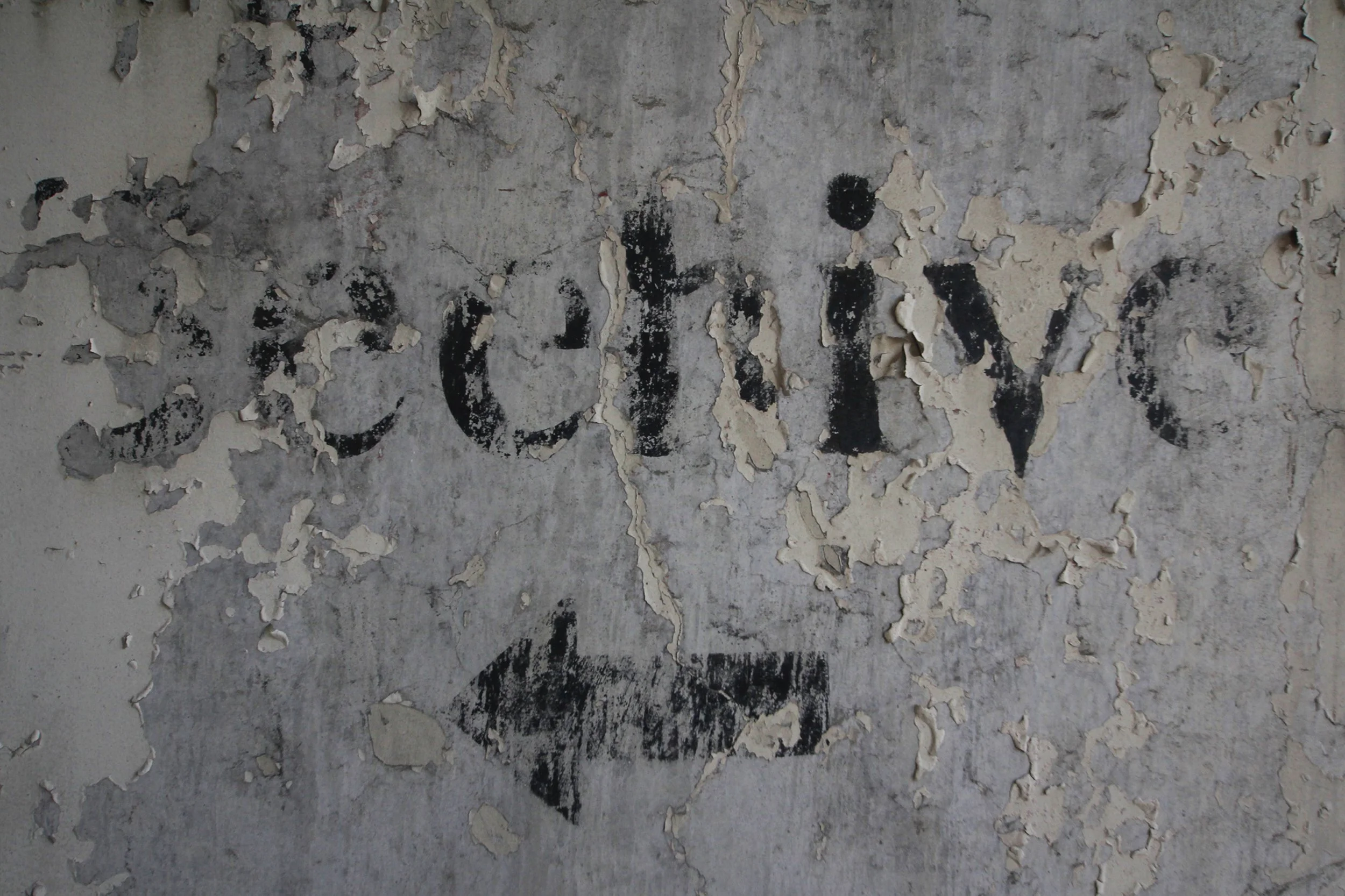
A ghost sign/fading advertisement for the defunct Beehive as seen at Cincinnati’s riverfront arena in 2015.
Downtown Cincinnati’s Riverfront Coliseum was built with the National Hockey League in mind, but it’d have to settle for the World Hockey Association—at least, temporarily. Intended to rival the NHL, the WHA had come out swinging with lucrative and often ludicrous contracts in an effort lure star players away from the old guard, yet it could never truly sustain such frivolity. Rather, the renegade league’s ever-changing cast of co-conspirators figured they just needed to keep the theatrics going long enough for their established competition to relent and cry “merger.”
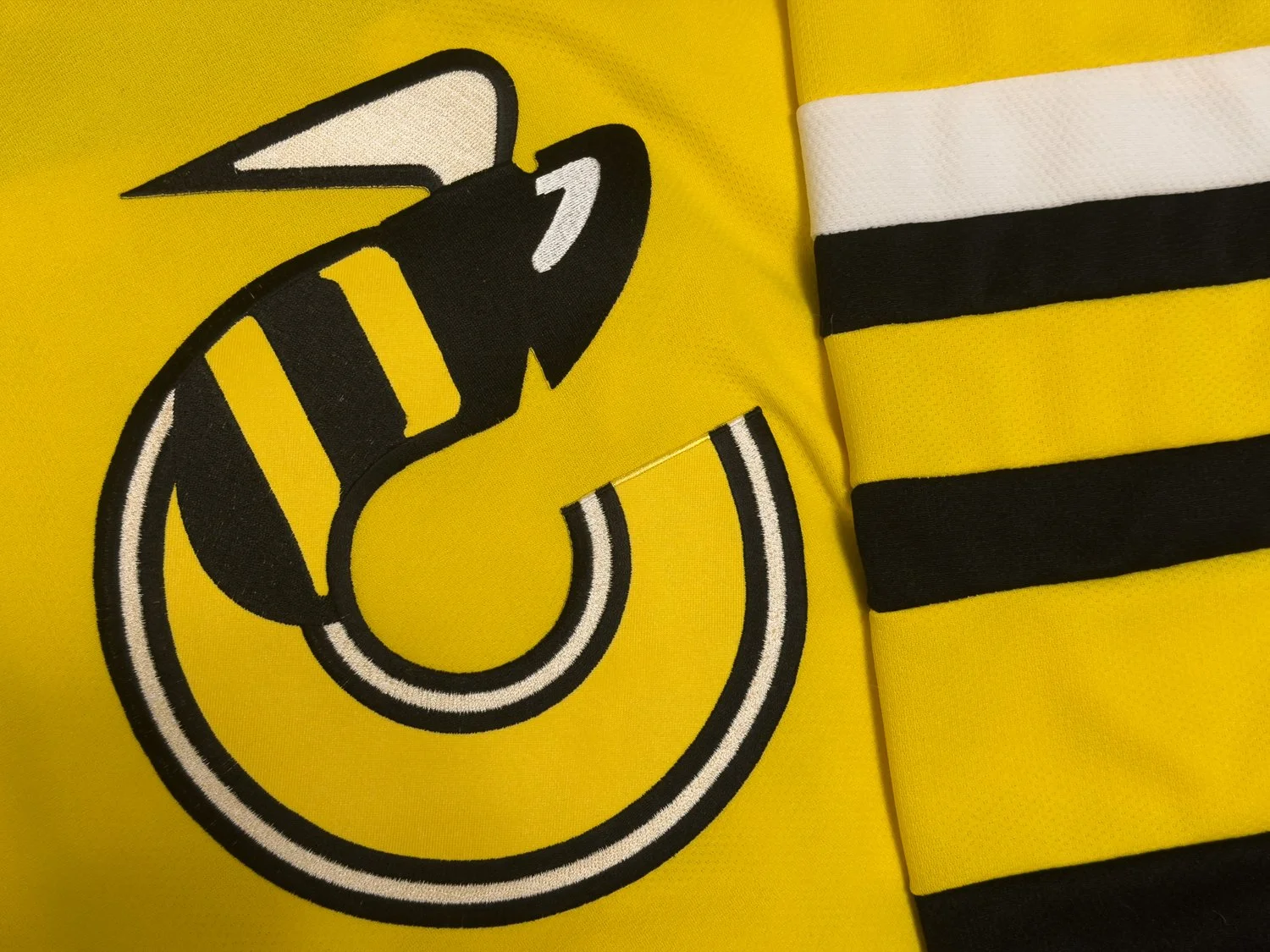
One of my most prized possessions—a Cincinnati Stingers jersey.
The Cincinnati group was invested—not only in a WHA expansion club, but this longterm vision. Although they’d previously been turned down by both the NHL and a local government who' declined to give them public money for their arena, they’d still found a way to chase their major league hockey dream with private funds.
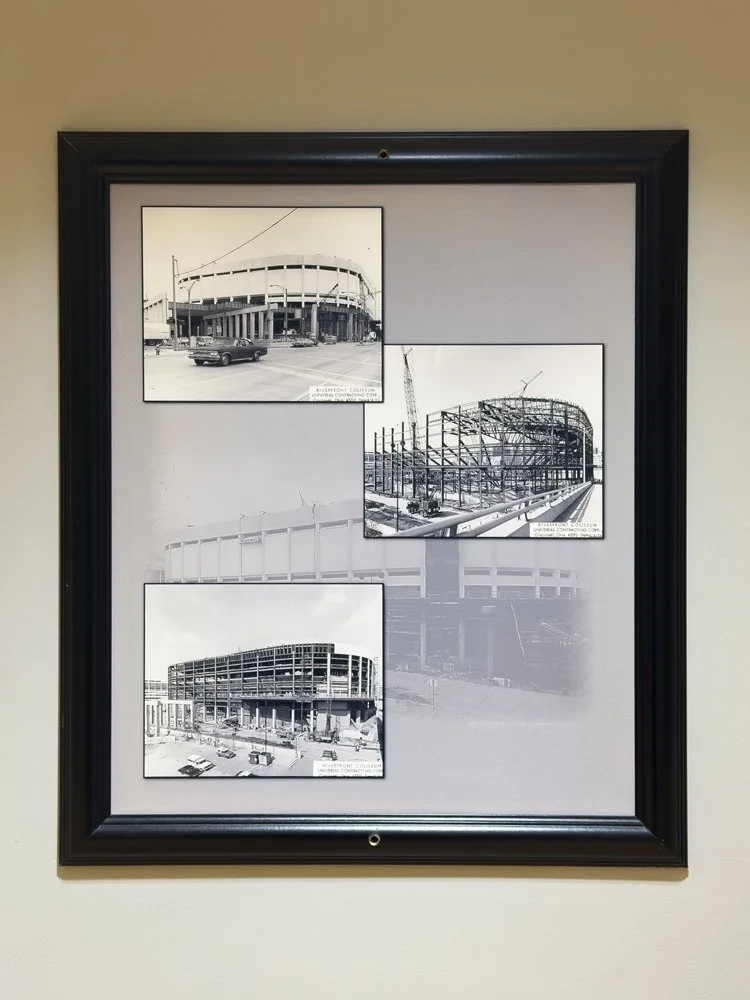
The Riverfront Coliseum under construction in 1974 as seen on the walls of the building’s All-Access Bar & Grill in 2025.
And finally, on an October night in 1975: they toasted to the Cincinnati Stingers and watched from the swanky, suite-level “Beehive” as their new team skated onto the ice.
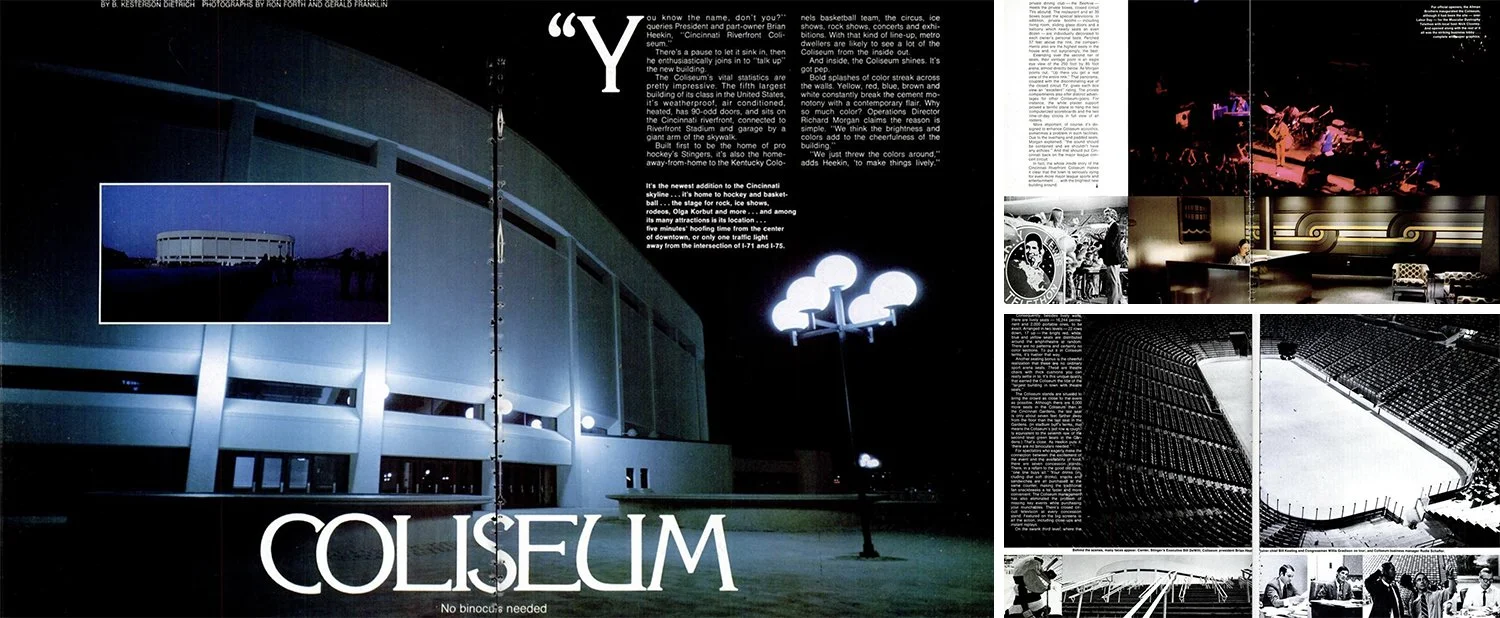
The Riverfront Coliseum profiled in an October 1975 issue of ‘Cincinnati Magazine.’
If you go sit in that club today, though, and peer up from the arena floor into the rafters—you won’t see any mention of the Stingers. Rather, the banners hanging up there are for the Cyclones, the franchise that’s now the most storied in Queen City hockey lore. They’re not just an established entertainment option touting the minor league hallmarks of family-friendly promotions and cheap beer, but also an institution with a loyal fanbase, two championships, and a bevy of other on-ice accolades.
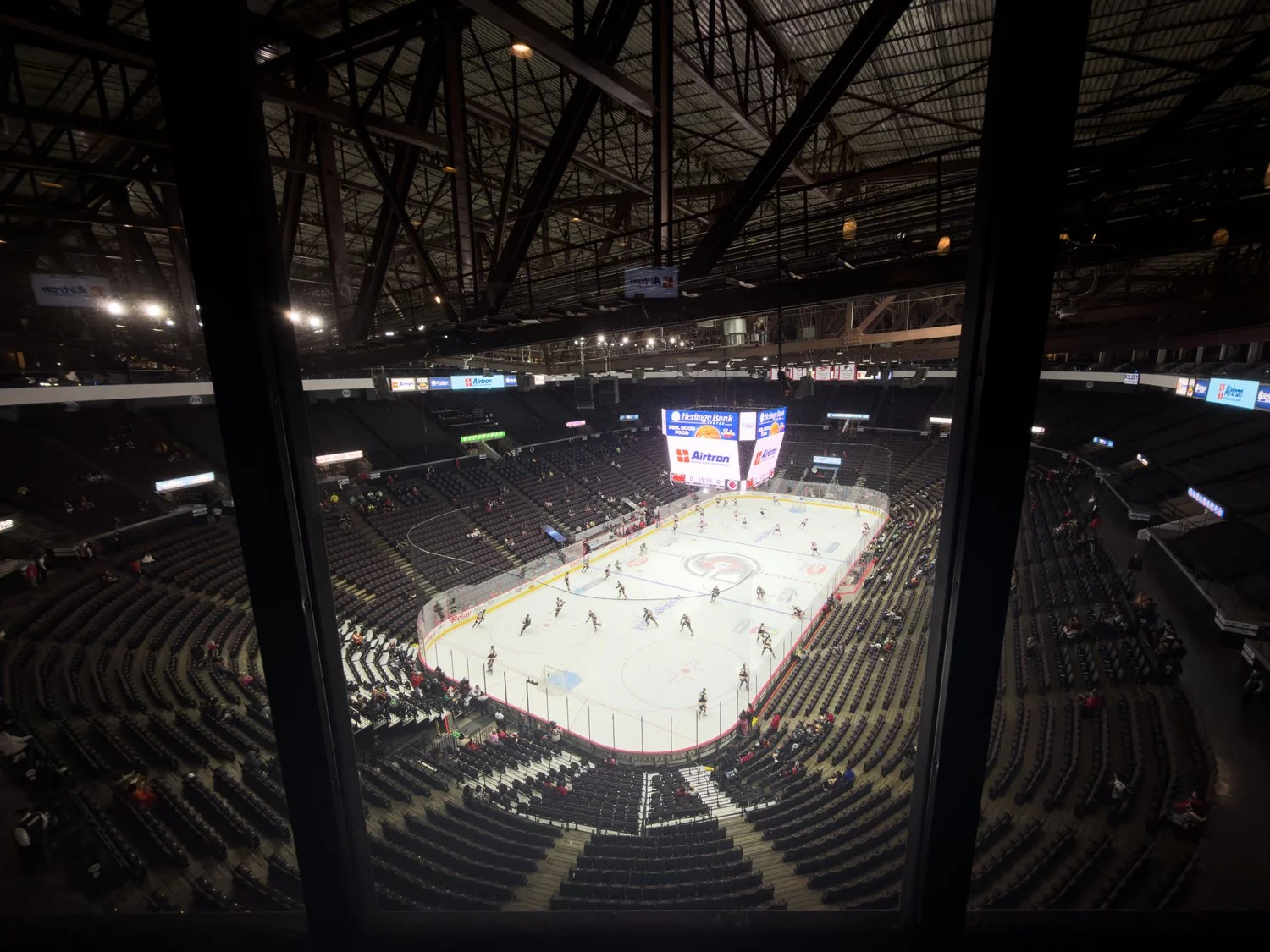
Heritage Bank Center [formerly: the Riverfront Coliseum] as seen from the All-Access Bar & Grill [formerly: the Beehive] on October 30, 2025.
The Cyclones had jumped from the city’s classic barn to a freshly renovated, downtown Coliseum in 1997. The dream of the NHL in Cincinnati was long dead by that point, but with a handful of upgrades over the years—what’s now known as Heritage Bank Center still holds up fairly well for the AA level of professional hockey. The place isn’t a palace by any means, but it’s certainly not the pits either. Fifty years on, it’s still the region’s main venue for large touring acts whether they be the brothers Jonas or Ringling.
Granted, I’ve certainly given this building its fair share of (deserved) grief over the years—the restrooms always seem to have some sort of liquid-like film on the floors, the concourses are cramped even when the crowds are low, the RC Cola offering is more of a novelty than a source of refreshment, and the part-time job I held there for a few months in college was truly one of the worst employment experiences of my life. However, despite my opinions, the building’s heartbreaking past, and a local political machine angling for its demise—the old Coliseum just keeps on keeping on.
And perhaps nowhere can that straightforward existence be appreciated more than in the former Beehive, or as it’s known today: the All-Access Bar & Grill.

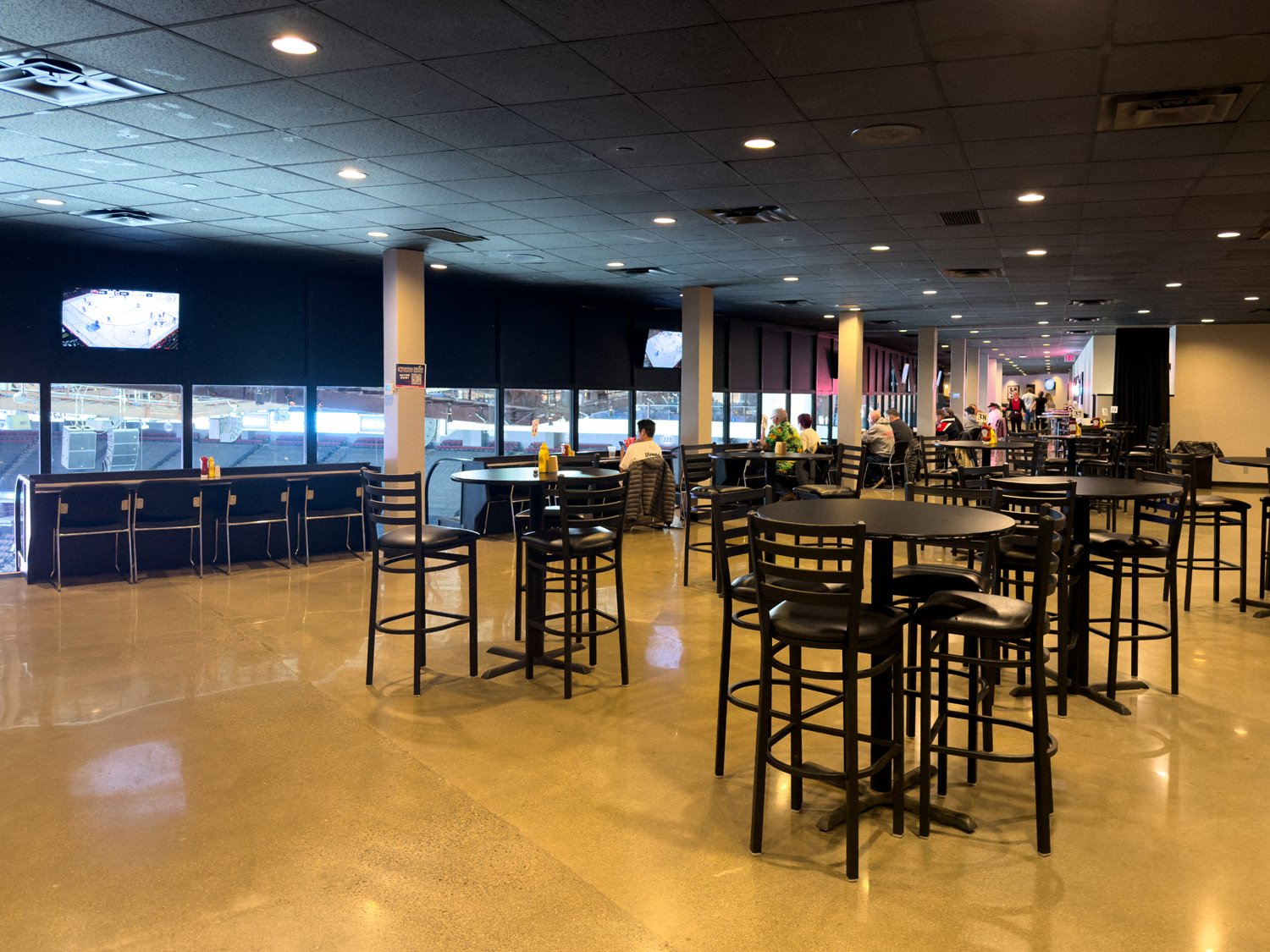
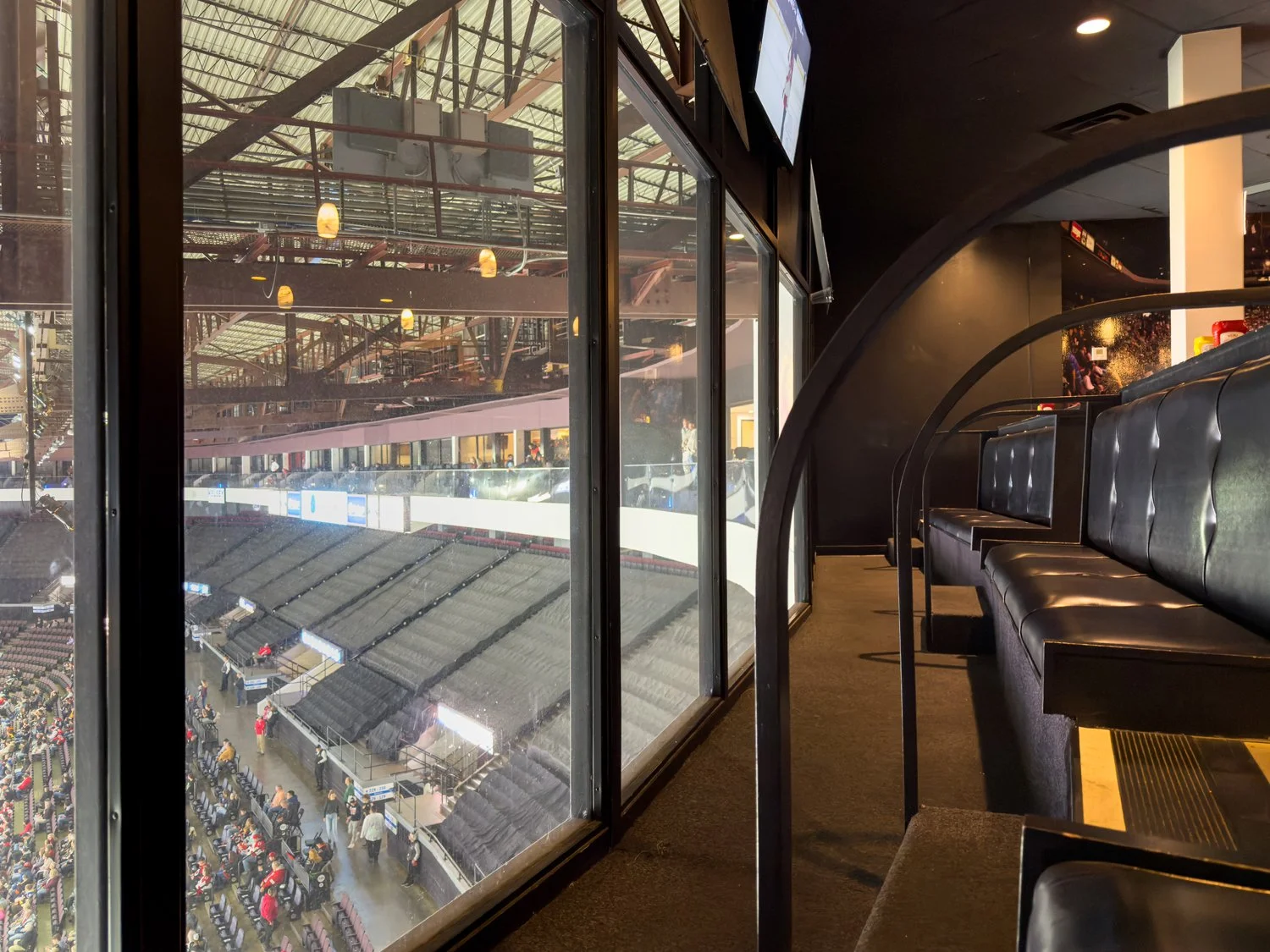
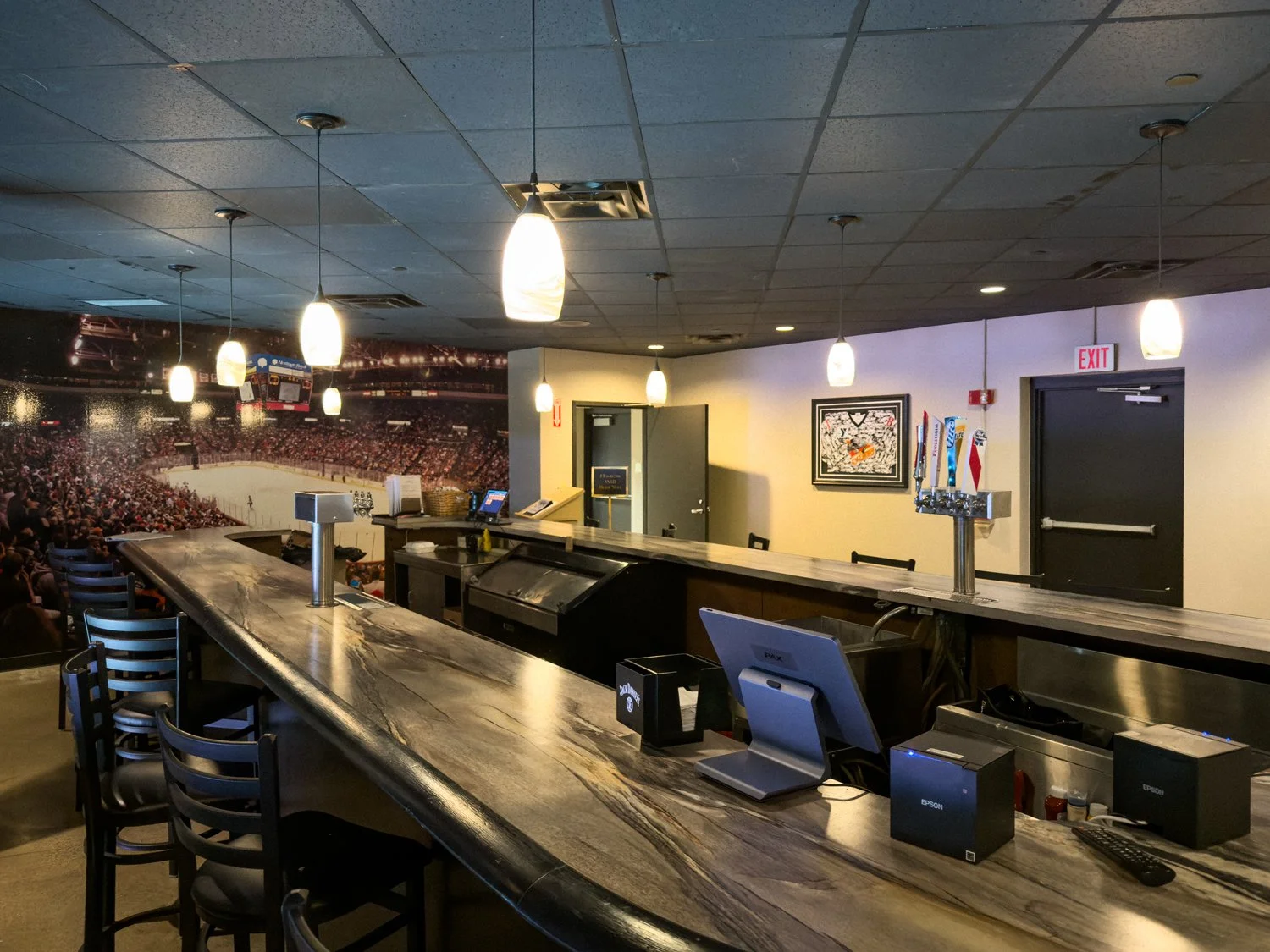
Gone with the Stingers were the days of paid memberships and steak dinners, and in their place: a casual spot to watch the “best game you can name.” It’s not really any different than a generic sports bar¹ and the food seemed to be group sales catering options repackaged as signature menu items—but it’s tasty enough, the service is great, and the beer promotions still apply. The name also holds up, as to get all-access to this bar & grill—one needs only a regular ticket and directions to the elevator.
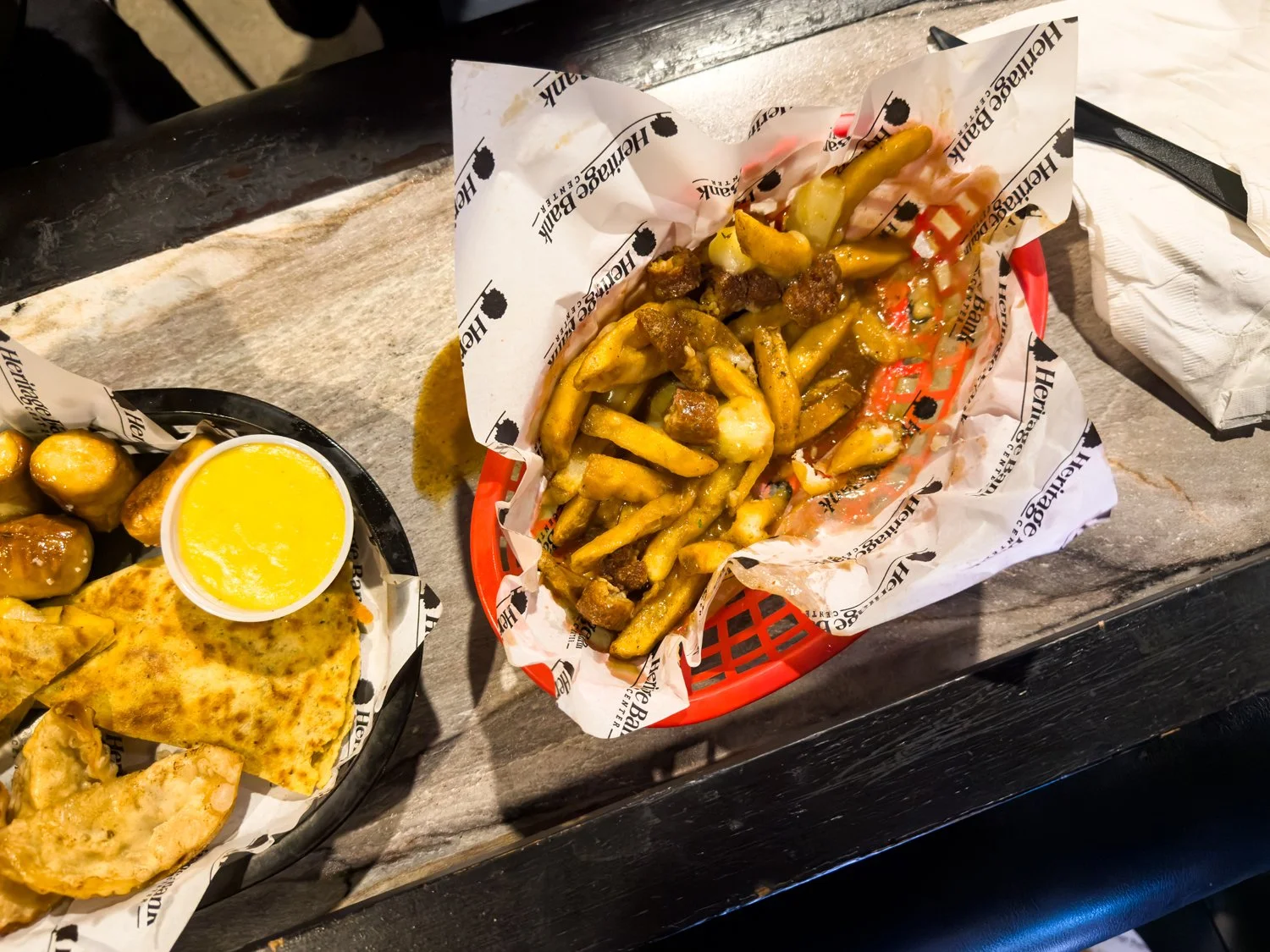
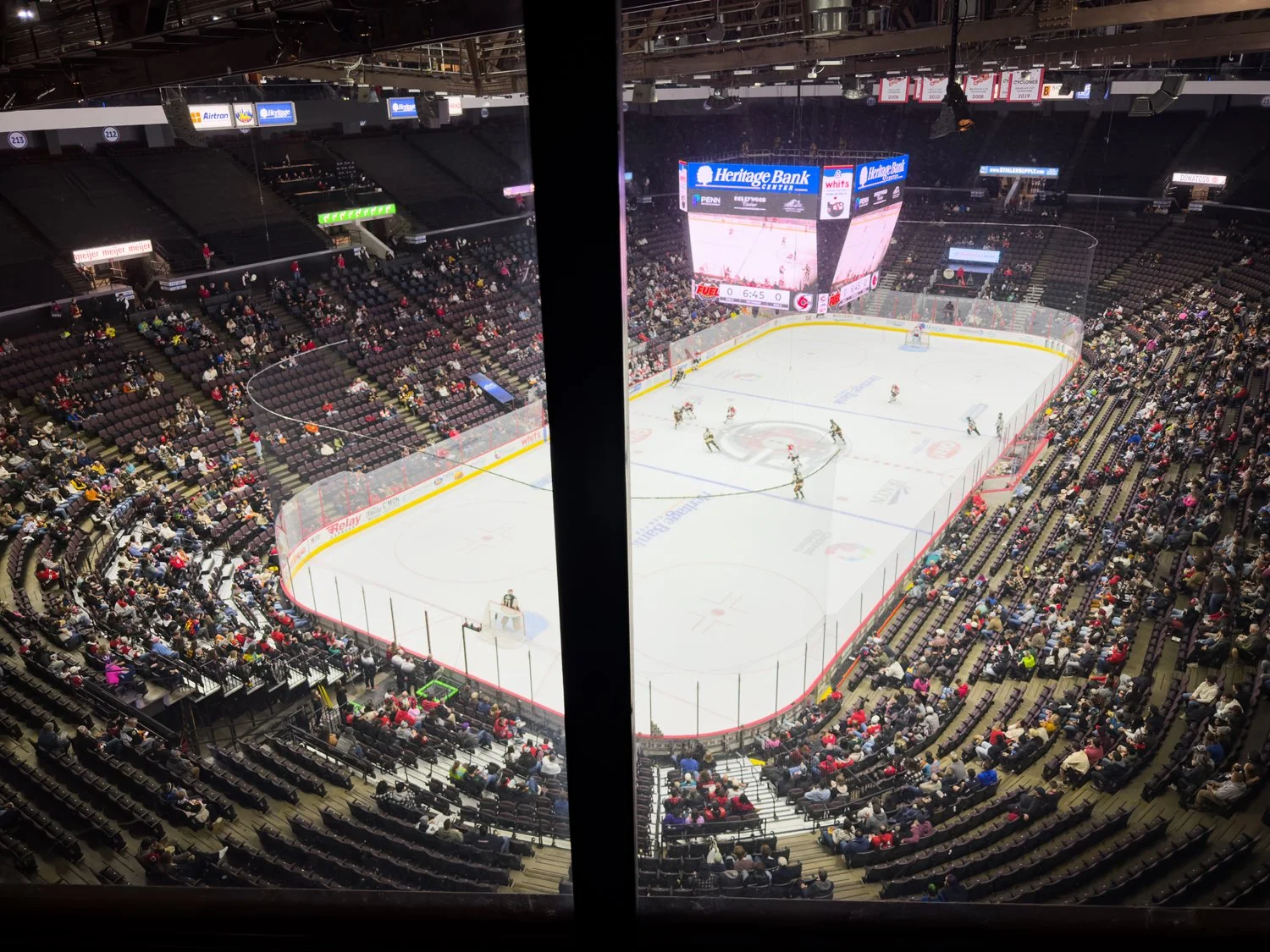

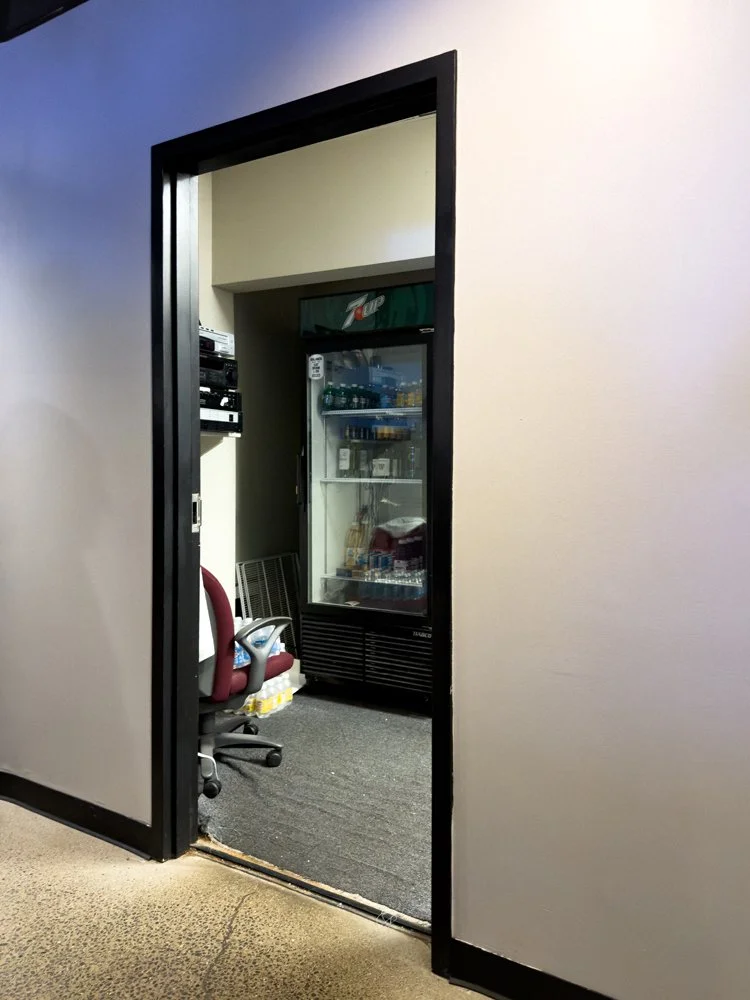
It’d been about fifteen years and two Kelly Cups since I’d last been up there, but this was a special occasion. I hadn’t gathered some friends and Lammi just to consume $2 High Life and once again rehash the tragedy of the Stingers. Rather, I wanted to discuss a similarly named team that was supposedly set to play a much different game.
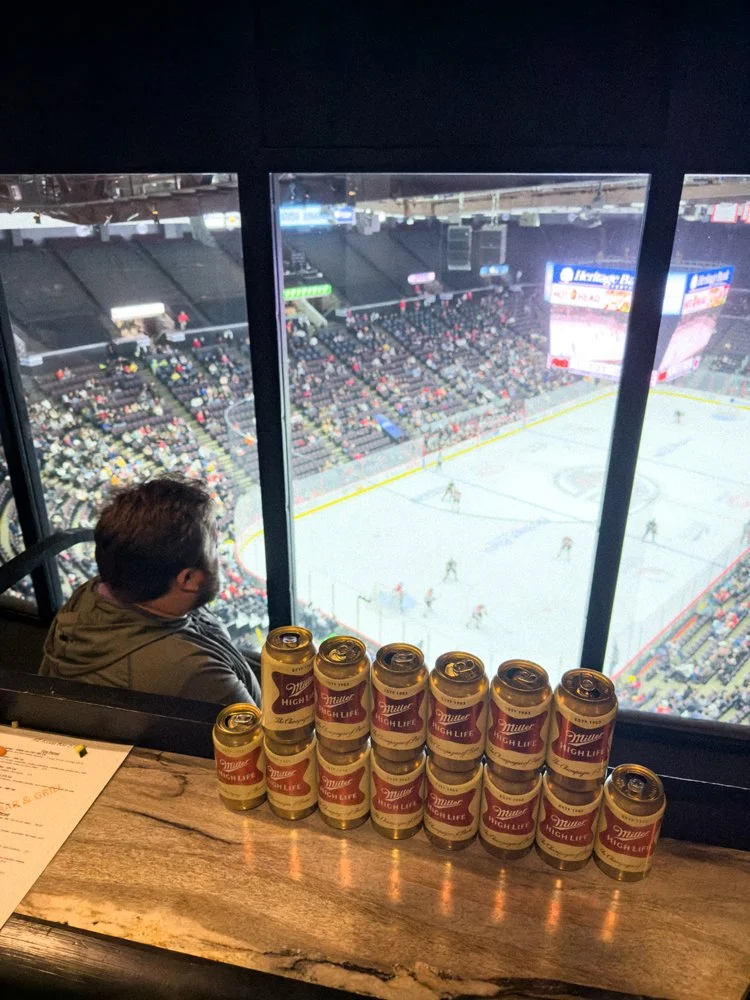
You have to celebrate when Lammi is in town.
Except, I never did get around to ranting about any of that—so here I am doing it while enjoying High Life at home.
It wasn’t my intention to author a detailed history of my hometown’s various indoor football teams—and this will be far from definitive—but I’d recently been inundated with e-mails and text messages asking if I’d heard about the Slingers.
Not the Stingers, but the Slingers.
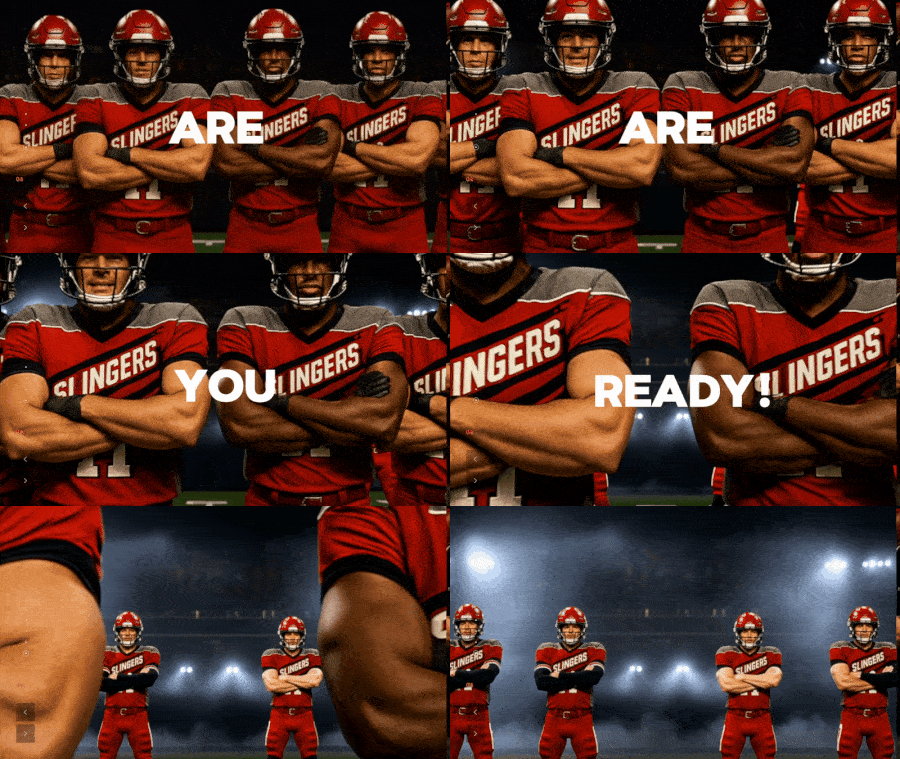
I’m not totally convinced that they’re real, but before we cast any doubts based on lazy AI websites, conflicting communication, and vague social media posts: let’s go back in time…
Semi-prologue:
The Birth of the A(rena) F(ootball) L(eague)
The place is New York City’s Madison Square Garden and the time is 1981. There and then, while attending an indoor soccer match, former NFL and original USFL executive Jim Foster had an idea: If international football could be scaled down and played indoors, why couldn’t American football? Thus, the first test game of Arena Football would be played in 1986 before a professional league launched in 1987.

The original Arena Football League logo. Fair Use/Wikipedia
While the helmets, shoulder pads, and astroturf may have looked familiar to American sports fans—certain things gave the league its own distinct flare. The signature, rectangular uprights were a visual hallmark and although the smaller field with less players might’ve seemed strange at first—it made for a more fast-paced, action-oriented version of the game.
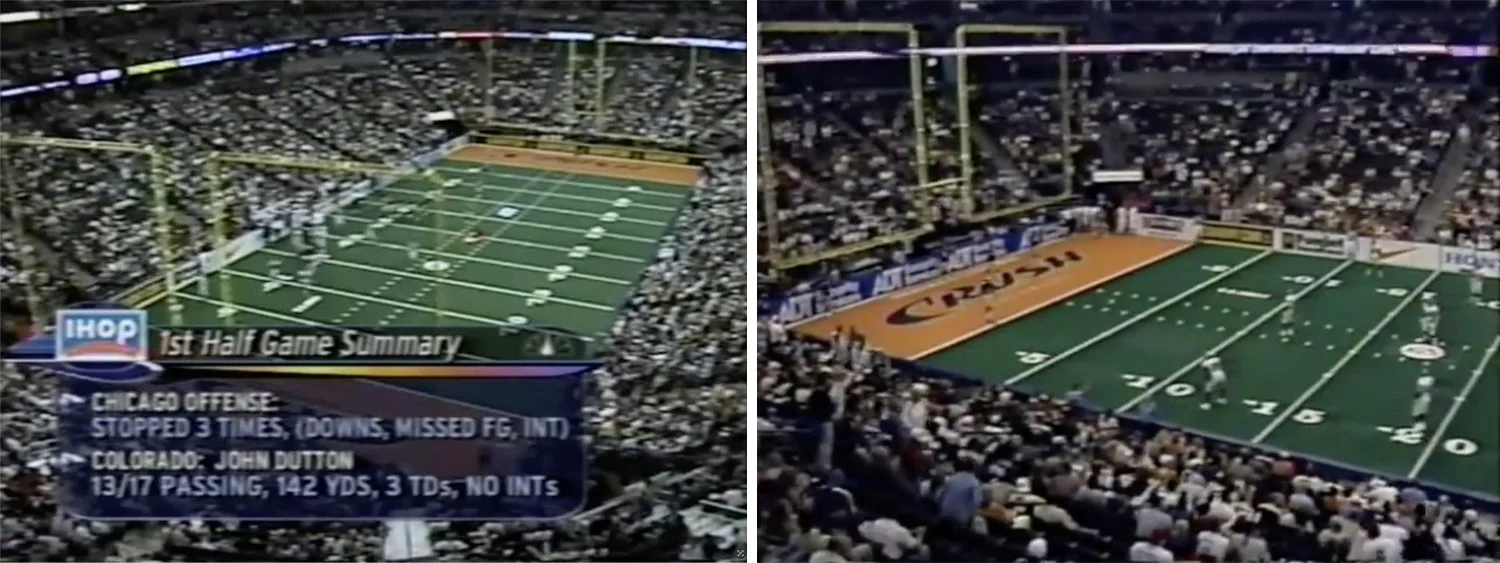
A regulation Arena Football field as seen at the Pepsi Center in Denver on June 5, 2005.
Screenshots from an NBC broadcast
It’s important to note that there’s a distinction to be made between the concept of indoor football and the product of Arena Football. While, even historically, it wasn’t unheard of to have both full and slimmed-down versions of the gridiron game played beneath a roof (the NFL determined its 1932 champion by doing just that), the original Arena Football League had sought to standardize and protect its version of football through legal trademark. This way, it could establish consistency across its markets and protect itself from imitators.
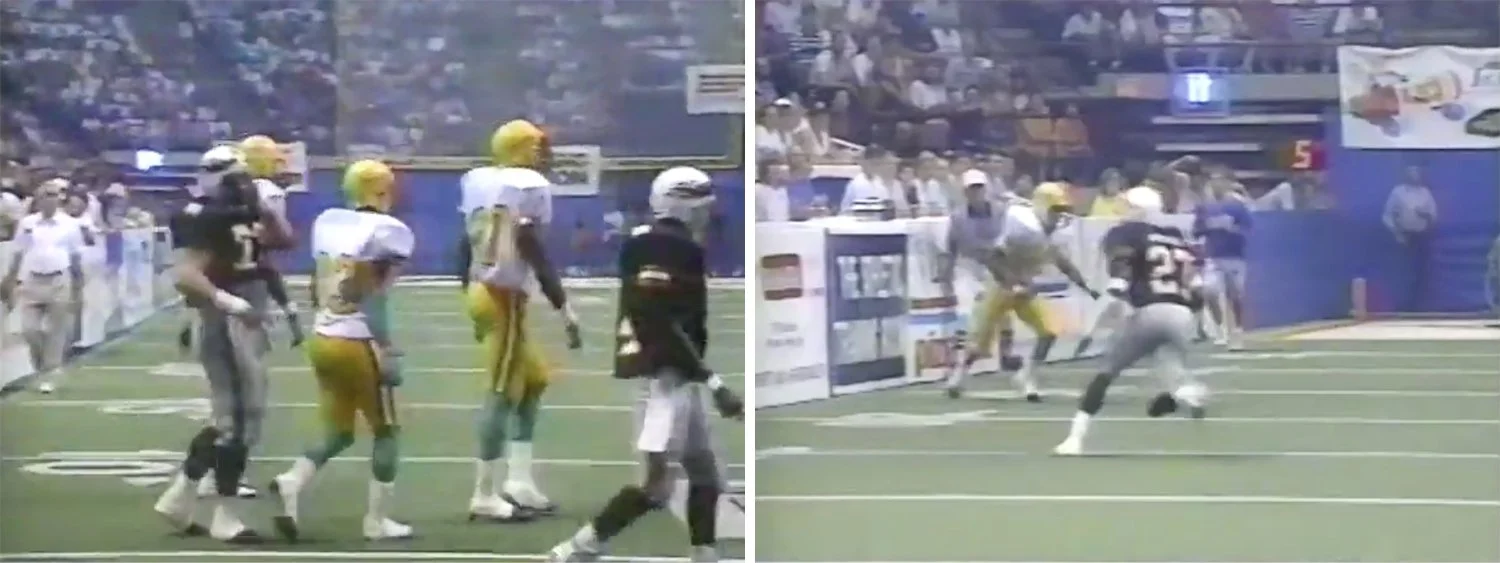
The Cincinnati Rockers (white) playing against the Albany Firebirds (blue) at Albany’s Knickerbocker Arena in 1992.
Screenshots from an ESPN broadcast
The AFL was also adamant that while it had no intention of being a competitor with the NFL, it wasn’t looking to settle as some sort of developmental or minor league either. Its spring-summer season would allow players to have opportunities in both organizations, but it also allowed franchises to establish themselves with fanbases and talent.
Yet, as the league continued to find its footing in 1991, only one of its original teams remained. And although they’d be gone for 1992—a fresh round of expansion was lined up for major American metros such as Phoenix, Charlotte, Sacramento, San Antonio, and Cincinnati.
Chapter 1:
Indoor Football on the Riverfront

Cincinnati Rockers logo.
Fair use/Wikipedia
The Cincinnati Rockers were announced by prominent, local father-son restauranteurs Ted and Tom Gregory (of Montgomery Inn ribs fame). The team began play in 1992 just as the next-door Bengals of the NFL were entering a particularly sordid period in their overall mediocre history. Whether folks were looking for a winning team or just curious to see the novelty of indoor football in-person, the Rockers claimed to have impressively sold “more than 5,700” season tickets for their inaugural campaign. They’d lose in the first round of the playoffs, but the team was able to boast a winning record and postseason berth right from the start.
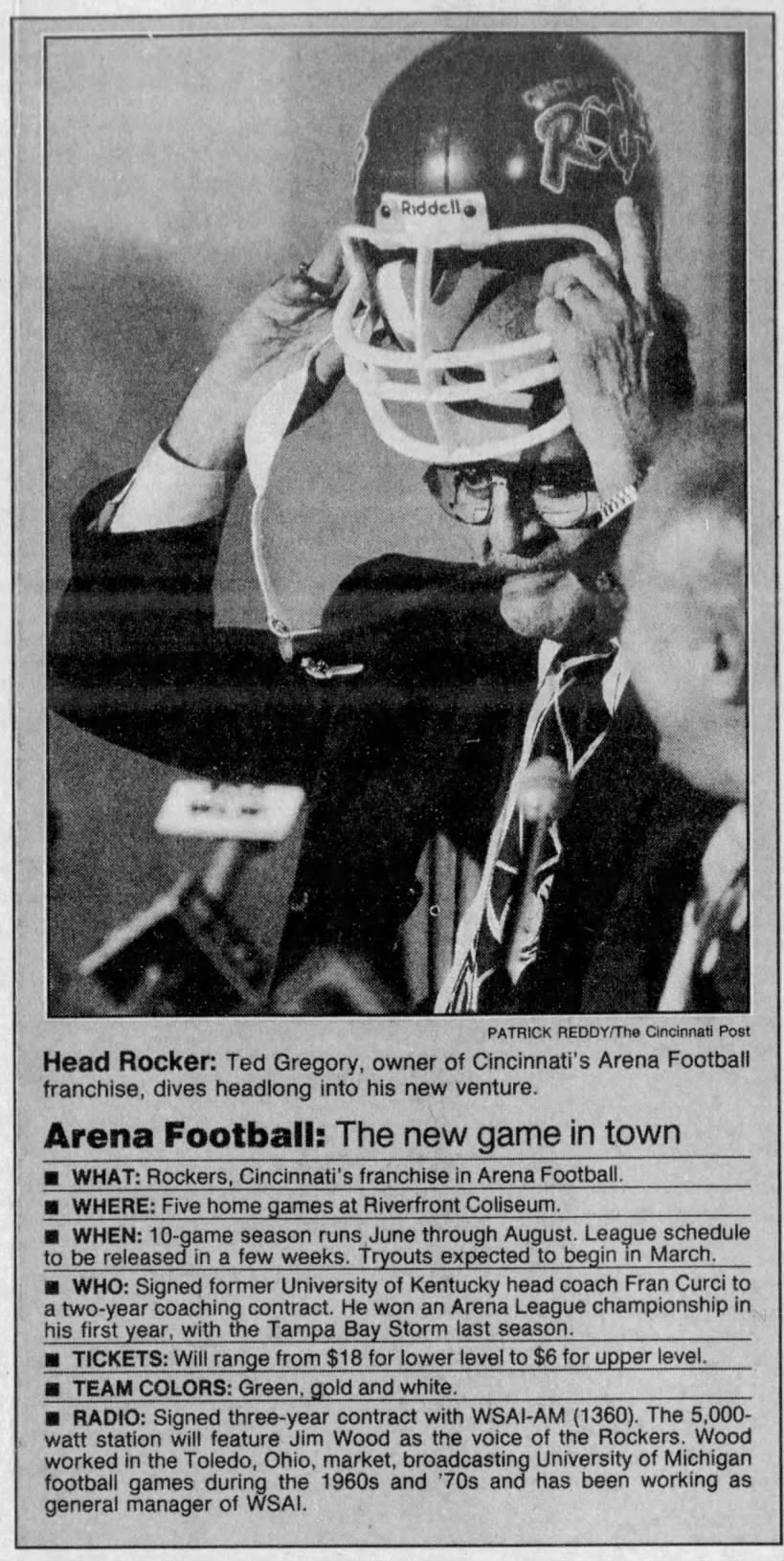
Rockers owner Ted Gregory seen in a clip from the November 21, 1991 edition of ‘The Cincinnati Post.’
Newspapers.com
Such success didn’t continue for the 1993 season, however. The Rockers went 2-10, their quarterback (former Ohio State University standout Art Schlichter) kept having gambling issues, and attendance at the Riverfront Coliseum was said to have plummeted.

Rockers advertisements clipped from the June 5, 1992 [Left] and Mar 15, 1993 [right] editions of ‘The Cincinnati Enquirer.’ Promoted highlights of the upcoming seasons include things such as “a chance to win a Geo Tracker,” “your favorite rock n roll music,” and the “Teenie Weenie Bikini section.”
Newspapers.com
After the demise of the Rockers, the City of Cincinnati was not represented by any indoor football team for nearly a decade. Yet, elsewhere: the AFL was still making a go of things. Sure, it was regularly playing musical chairs with teams via never-ending rounds of expansion, relocation, and contraction—but a few franchises had managed to earn loyal followings. And in some markets—Arena Football didn’t just work, it succeeded.
This gave rise to a handful of imitators—low(er) brow leagues who’d play a similar game in any city with an open venue and folks willing to spend money. Not necessarily Arena Football money, but indoor football money.
In an effort to stem the rising tide of perceived copycats, the AFL would eventually launch its own “minor” league.

AF2 Logo.
Fair use/Wikipedia
AF2 wasn’t necessarily intended to develop up-and-coming talent for the senior league so much as it was an effort to put a version of the trademarked Arena Football product in smaller markets that wouldn’t normally be considered. A strategy to not only grow the game, but also make some much-needed extra cash while countering the competition and reserving the “premium” product for “big-time” markets that’d be needed for television deals.
However, this raised a question for potential investors: why buy into the AFL when you can get the same thing (presumably) cheaper in AF2?
Swarm Logo.
Fair use/Wikipedia
And that seemed to be the mentality of several new teams in larger markets.
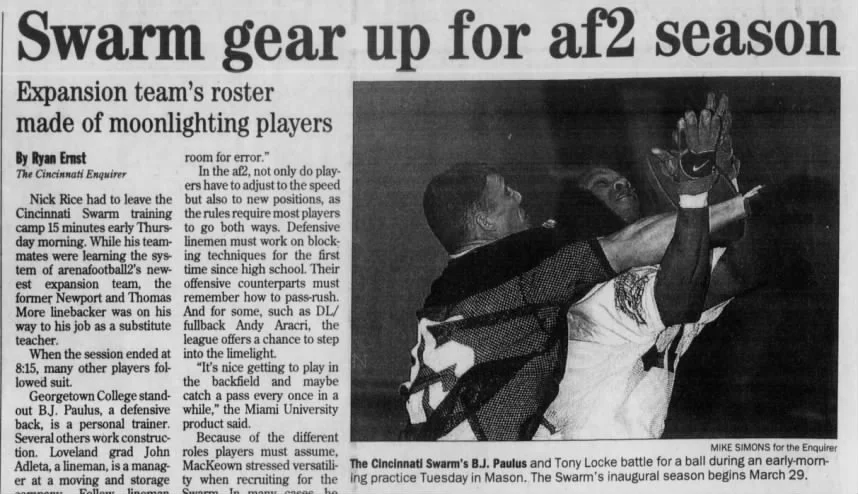
Clip from the March 23, 2003 edition of ‘The Cincinnati Enquirer.’
Newspapers.com
Both The Cincinnati Swarm and Sesame Street On Ice have the distinction of being the only attractions my 92-year-old Nana has ever seen at Cincinnati’s downtown arena. I don’t remember how or why she agreed to go watch the second-tier of Arena Football, but I’m not really in the mood to call and ask her. She won’t have any idea what I’m talking about and I don’t have the patience to argue with her about how she’s misunderstanding the news. No doubt, the new “communist” mayor of her hometown is somehow to blame for the downfall of a once proud, American institution such as Arena Football™.
…I did decide to call her after all, though, because it had been a while.
She didn’t remember the Swarm, but she did recall the Oilers “playing football indoors” at the Astrodome when she lived in Houston. She also reminded me that she “had” to go to all of her grandchildren’s events whether it was karate (Tae-Kwon-Do), YMCA ballet (fair enough), or musical theater (if we’re being honest, the Catholic grade-school version of The Little Mermaid did deserve to flounder at the box office).
What she was really trying to say, though, was this: after having sat through all that, how the hell would she remember going to see the minor league of an alternative sport in a generic arena 22 yeas ago?
This lady (whom I truly love) also claims she once sat next to KISS frontman Gene Simmons on an airplane. I only mention that because Gene once owned an AFL franchise themed to his band: the Los Angeles KISS.
Anyways, the Swarm went 7-9 for their sole 2003 season. Their mascot’s name was “Buzz” and this photograph of him exists on Wikipedia:
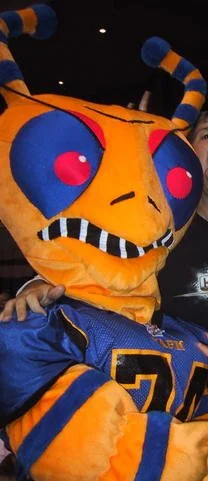
“Buzz”
Fair use/Wikipedia
Despite the introduction of AF2—rival leagues continued to regularly pop up across the country. One of those was the National Indoor Football League (NIFL) whose middling efforts would bring a team to the Queen City in 2005.
The Marshals logo.
Fair use/Wikipedia
The Marshals had once called Waco, Texas home, but upon moving to Cincinnati—their owner “fled the United States entirely after being suspected of money laundering.”
That’s what Wikipedia says, anyway.
There isn’t a link to a source which backs that claim up, but such a scenario isn’t necessarily uncommon among the annals of fly-by-night, pseudo-professional leagues playing off-brand sports.
The same lacking-in-credibility-but-really-fun-to-read Wikipedia entry does go out of its way to mention that the next ownership team was committed, though. So much so that the Marshals returned for a second season in 2006, tying the Rockers for the prestigious title of Cincinnati’s then-longest tenured indoor football club.
They even made it to a third season, but that one required relocation an hour north to nearby Dayton’s classic Hara Arena because the Marshals had been replaced with a different indoor football effort at their now-former home.

Jungle Kats logo.
Fair use/Wikipedia
In 2005, the Bengals had made the NFL playoffs for the first time in fifteen years, reinvigorating chants of “Who-Dey” among misanthropic locals. And what better way to capitalize on a Queen City football renaissance than by launching the thrift store version of a dollar store team?
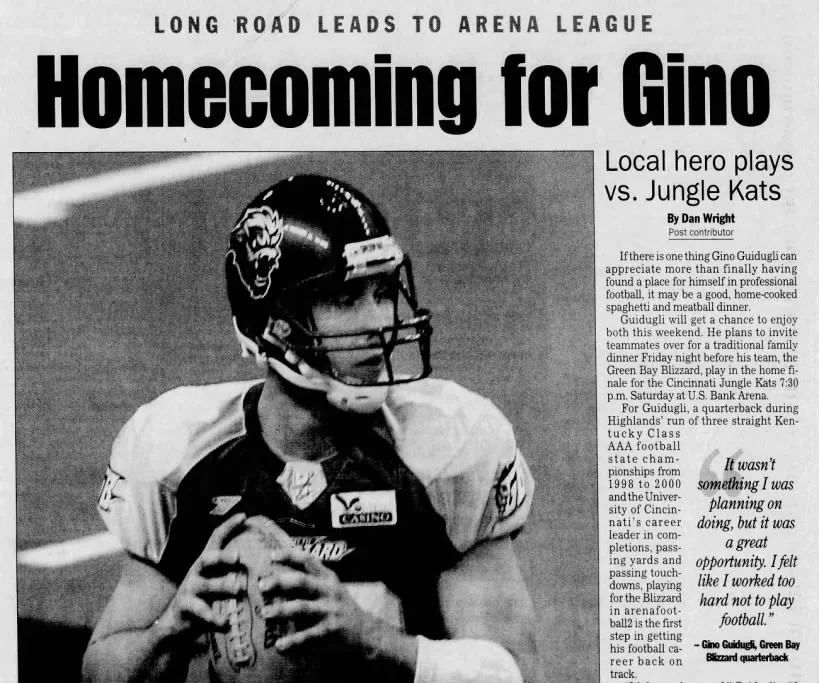
Clip from the July 12, 2007 edition of ‘The Cincinnati Post’ highlighting native football standout Gino Guidugli returning home to play against the Jungle Kats.
Newspapers.com
Although the AFL was doing well enough for itself in 2007—an ownership group boasting names like Bengals star Sam Adams and Reds star Ken Griffey Jr. had opted yet again for AF2. The Cincinnati Jungle Kats would end up going 1-15 with barely anyone remembering their single 2007 season, marking the end of indoor football at the downtown arena.
At least, for now.
Chapter 2:
Championships and a “Hefty Lefty”
By 2009, both the AFL and AF2 were headed for bankruptcy. What little remained of each league merged in 2010 to reform as AFL 2.0. At the same time, though: all of those rival, smaller leagues were about to fill the power vacuum that’d emerged in this incredibly niche world.

Cincinnati Commandos logo.
Fair use/Wikipedia
I first heard about the Cincinnati Commandos when they randomly showed up on Wikipedia as a “tenant” of the Cincinnati Gardens (Wikipedia has always been the best source for initial indoor football research). Somehow, they had a detailed entry before any website or press release had come out. Yet, despite not seeming real and me figuring it as a someone putting on an elaborate, inside joke—the team became the historic Gardens’ first indoor football venture. Although playing in a league made up of much smaller markets and even one travel-only team, the Commandos were able to command impressive crowds thanks to free parking and $1 Natty Lights. The relatively new Continental Indoor Football League also advertised that any balls which went into the stands could be kept by lucky fans.
.png)
CIFL logo.
Fair use/Wikipedia
I went to that first Commandos game, though, and this promotion was quickly rescinded after it became clear that such a benefit was unsustainable for teams that happened to not only draw fans, but also score numerous times. As 10,000+ packed into the Gardens that night, the announcer was pleading with spectators to return loose balls during breaks that also included staff using vacuum cleaners on the turf to suck up shards of glass bulbs that had fallen from punts smacking into the old scoreboard.
It was great.
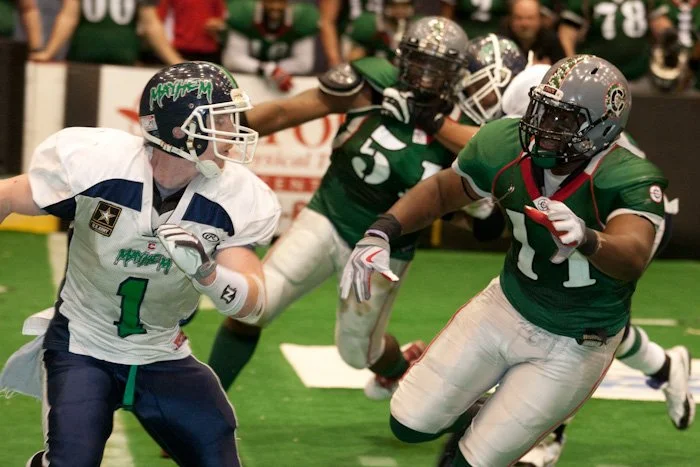
The Cincinnati Commandos (green) at work against the Marion, Ohio Mayhem (white).
Archive.org/CincinnatiCommandos.com
Led by former (and successful) University of Cincinnati quarterback Ben Mauk, the Commandos weren’t messing around. In their first season, they’d lose only one game before capturing the CIFL title.
Then they did it all again for 2011, except they were never beat that year.
Even after switching to the United Indoor Football League for 2013, they’d finish off their third year in existence with a third straight championship.

UIFL logo.
Fair use/Wikipedia
Then, they just disappeared.
And, sadly, not long after: so did the Gardens.
The Commandos at the Cincinnati Gardens.
Archive.org/CincinnatiCommandos.com
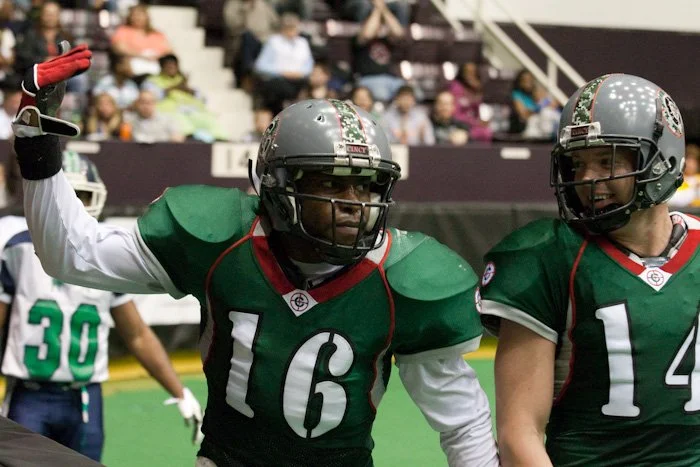
The Northern Kentucky River Monsters debuted as members of the UIFL in 2011 while the cross-river Commandos were chasing their second championship in the CIFL.
River Monsters Logo.
Fair use/Wikipedia
Playing at The Northern Kentucky University’s basketball arena in suburban Cincinnati, Ohio—the River Monsters would then go dormant before being revived in 2014 and taking the opposite path of their now-defunct competition by switching to the CIFL.
For both seasons, the team boasted the uniquely large stature of Jared Lorenzen. Confidently playing quarterback at 320 pounds, the “Hefty Lefty” had found some success in the NFL before moving on to have fun in the various indoor leagues (he was even once commissioner of the UIFL).
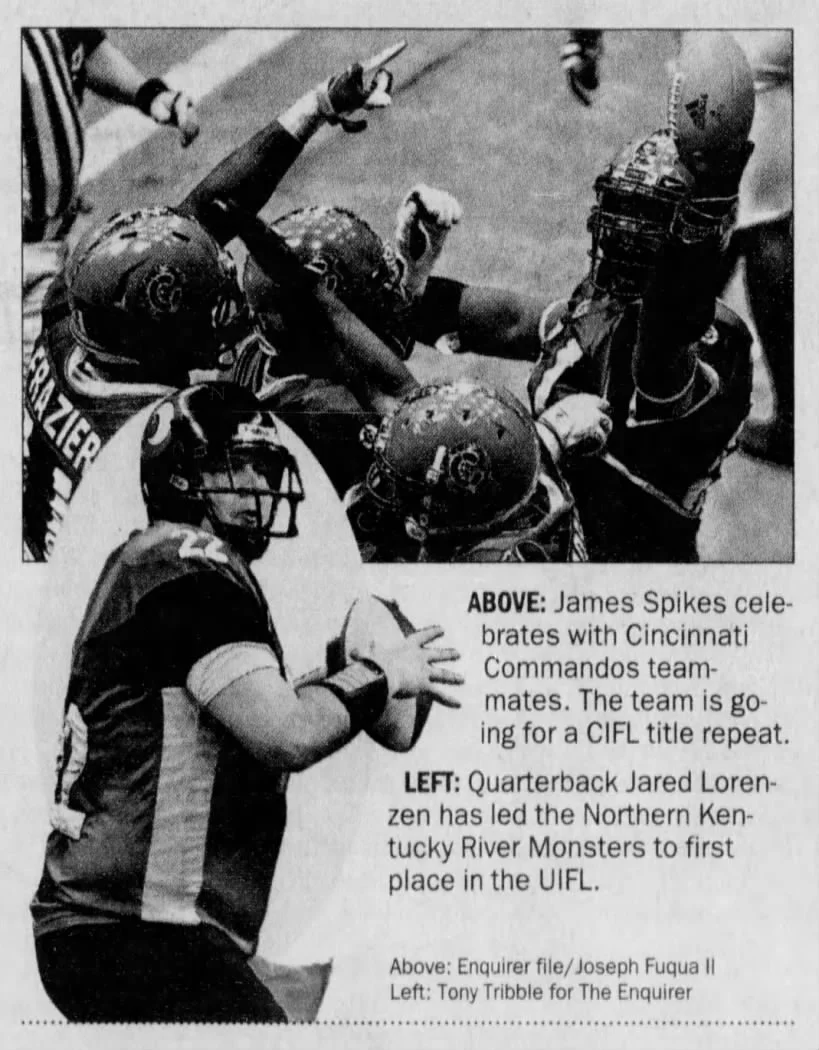
Jared Lorenzen shown in a profile of both the Commandos and River Monsters from the May 18, 2011 edition of ‘The Cincinnati Enquirer.’
Newspapers.com
A beast of an athlete, the guy could throw down the “field” with ease and outperform any amateur who dared to challenge him physically. However even after Lorenzen led the River Monsters to a winning season and a playoff berth in 2014, the team would once again fold. And sadly, five years later, Lorenzen would pass away at only 38 years old.
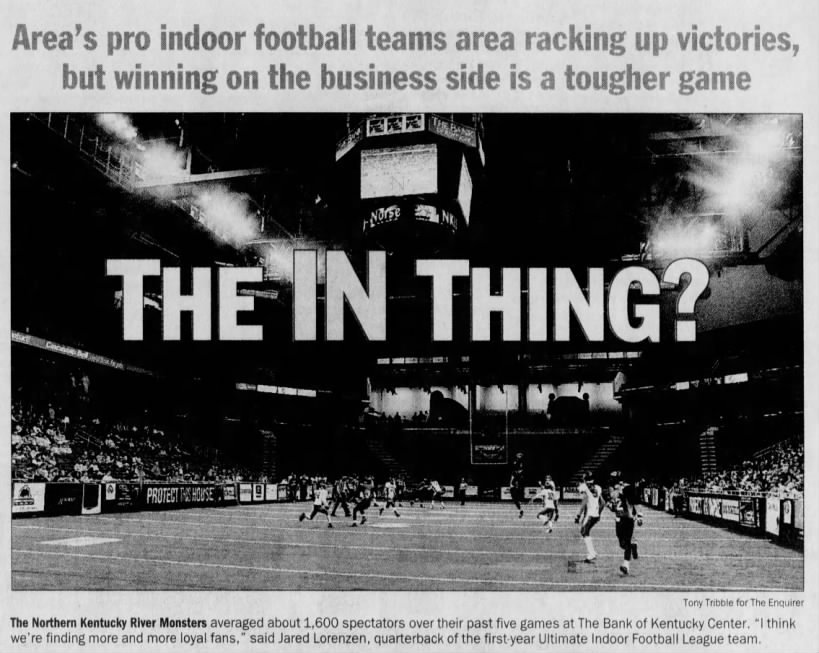
Highlight of the River Monsters as seen in the May 18, 2011 edition of ‘The Cincinnati Enquirer.’
Newspapers.com
The Northern Kentucky Nightmare would emerge as successors to the River Monsters in 2016, but until I was discussing this whole story with my Dad—I had no idea they ever existed (thanks, Dad).
Northern Kentucky Nightmare logo.
Fair use/Wikipedia
Apparently, this team which utilized the “Batman Forever” font, played only road games during their lone season as part of the league known as American Indoor Football.
Chapter 3:
Honorable Mentions and Questionable Intentions
At one point in its history, the AFL had become established enough that it’d spawned multiple mainstream video games. However, while the league’s product was at least generally known to sports fans, the teams themselves weren’t. There were a few longstanding franchise in places like Phoenix and Philadelphia, but the league had been in and out of so many markets (some of them numerous times), that there had rarely been any real consistency between cities and rosters.
Despite the AFL and AF2 having combined to re-emerge as AFL 2.0 in 2010, the sequel version would ultimately end in another bankruptcy by 2019. But even as the aptly named Indoor Football League began to emerge as the new, preeminent organization in the sport—the Arena Football brand wasn’t quite dead yet.
The logo used for the later days of AFL 1.0, as well as, AFL 2.0 and AFL 3.0.
Fair use/Wikipedia
Announced in 2023, AFL 3.0 had managed to secure the name and likeness of the original league, but seemed to be even more-so mismanaged. After an announced list of initial team locations simply stated “Ohio,” Cincinnati was confirmed to be The Buckeye State’s entry into the new league. However, as the local media kept chasing the story, no local venues had any idea what they were talking about. None had even been approached about a team, let alone signed any kind of agreement.
Ultimately, Cincinnati and several other announced locales never actually materialized in a league that ended up being filled with mostly smaller markets. After playing its championship game in New Jersey’s Mall of America imitator—the league would fold with hardly anyone noticing..

Wordmark for AF1, which is essentially AFL 4.0.
Fair use/Wikipedia
From the ashes of AFL 3.0 then rose Arena Football One. A far cry from the aims of the 1980s, this new eight-team league seemed to truly embrace any market that would take it—from the bright lights of Nashville to both Salina and Dodge City, Kansas. Four teams were already gone after AF1’s 2025 season, but it plans to play again in 2026 with several expansion clubs—one of them being slated for the Cincinnati area.

Kentucky Barrels logo.
Fair use/Wikipedia
The Kentucky Barrels will be the second indoor football team to play at NKU’s Truist Arena and by all measures appear to be making a genuine effort.
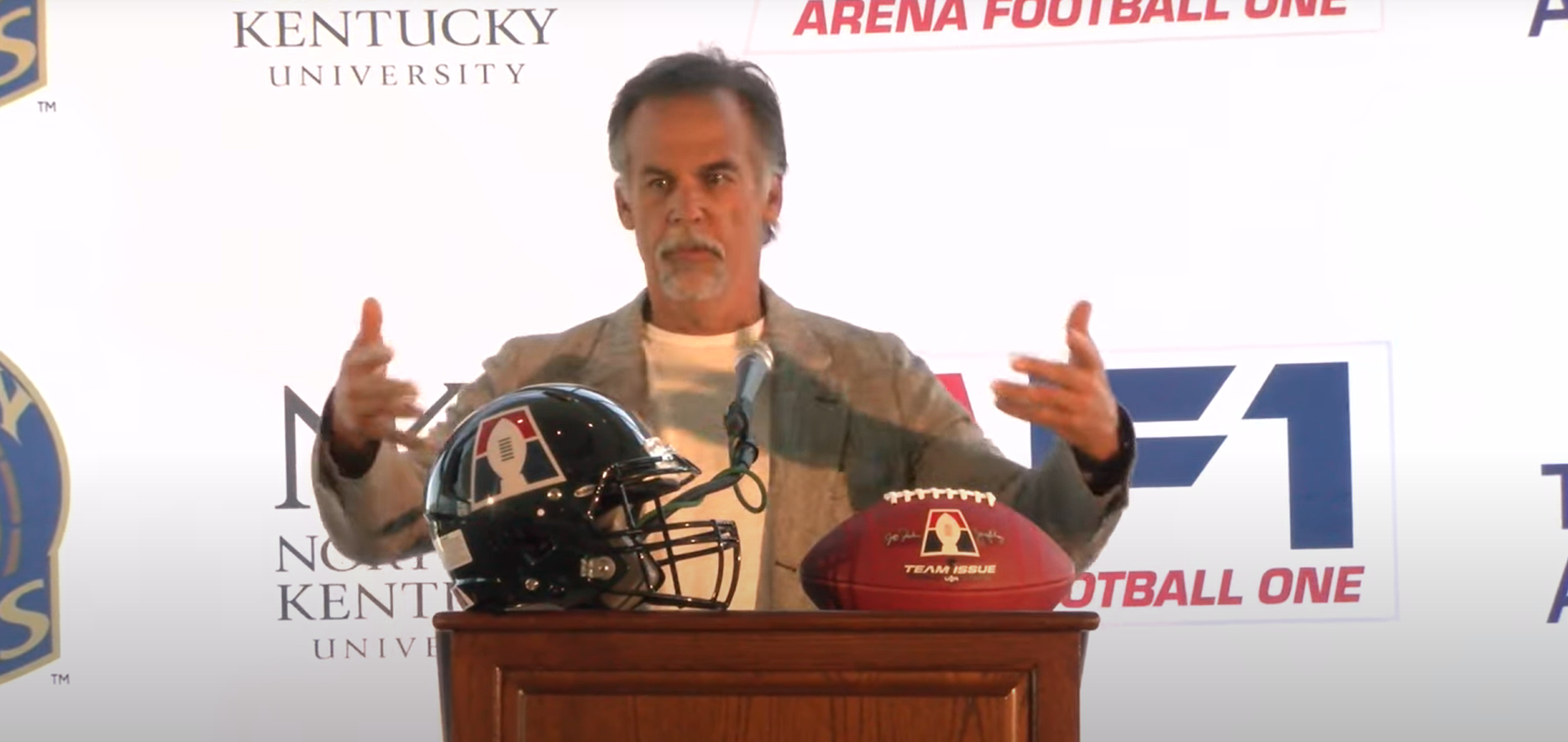
AF1 Commissioner and Former NFL Coach Jeff Fisher announcing the Kentucky Barrels in August 2025.
Arena Football One/YouTube
They’ve announced a Head Coach/General Manager, player signings, merchandise, and have even held tryouts. In an emotional August 2025 introduction, team owner Corey Cunningham thanked his family and partners for helping make the team a reality:
“Everybody’s put in a lot of hard work—we don’t even start for another eight months and everyone in this room has helped us out so much already. It’s just overwhelming and it’s so humbling. Thank you, everyone.”
And in a niche sport that’s now a far cry from its heyday—every bit counts.
Especially if you end up having direct, in-market competition.
Cincinnati Slingers logo.
Facebook
I sincerely appreciate that whenever news slips out about some minor, off-shoot, pseudo professional, and alternative sports team coming to town—there are several people in my orbit who will check in and ask: “did you see this?” I’m not saying that my takes or opinions on these random matters are above anyone else’s—it’s just that I really love these tales of off-shoot leagues trying to make a go of it in the ‘Wild Wild West’ underbelly of pro sports. When you follow this stuff for a while, though, you start to notice trends. And when you combine that knowledge with the passage of time, as well as, a healthy skepticism for Linkedin language and marketing buzz words—you can often be pegged as cynical.
Cynicism, like respect, however—is earned.
Which leads us to: The Cincinnati Slingers of the International Arena League who will purportedly bring indoor football back to Cincinnati’s riverfront at what’s now-called Heritage Bank Center.
But here’s the deal: since I started working on this story a few weeks ago, I’ve re-written this section more times than I can count.
It’s certainly not uncommon for fledgling, minor leagues to still be solidifying details or working out specifics down to the wire, but for this endeavor—which claims that it’s not only going to kick off in four months, but also be an international effort—I’m skeptical.
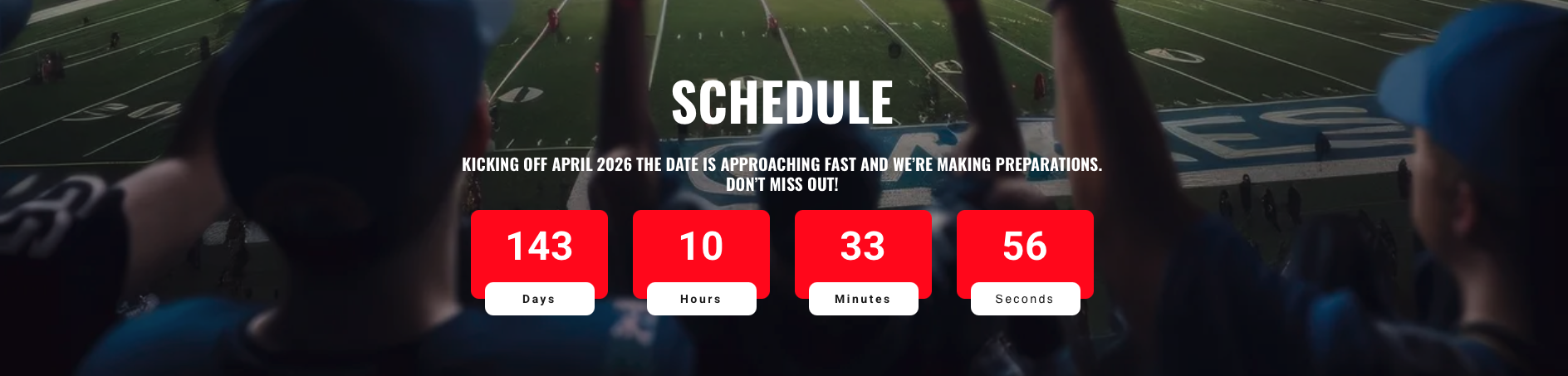
Countdown for the International Arena League as seen at IALfootball.com on Nov. 26, 2025. Note the low-quality AI image in the background.
Both the team and league websites have consistently been awash with low-quality AI content, generic imagery, and conflicting information. Everything looks like one of those pop-up ads for an offshore betting website—the kind you get when illegally streaming sports (or so I’ve heard). Promotional graphics on the Slingers website tout generic, AI-generated players standing center among notable Bengals such as current quarterback Joe Burrow, as well as, former stars Carson Palmer and Boomer Esiason (none of whom, by any indication, have anything to do with this league or team).
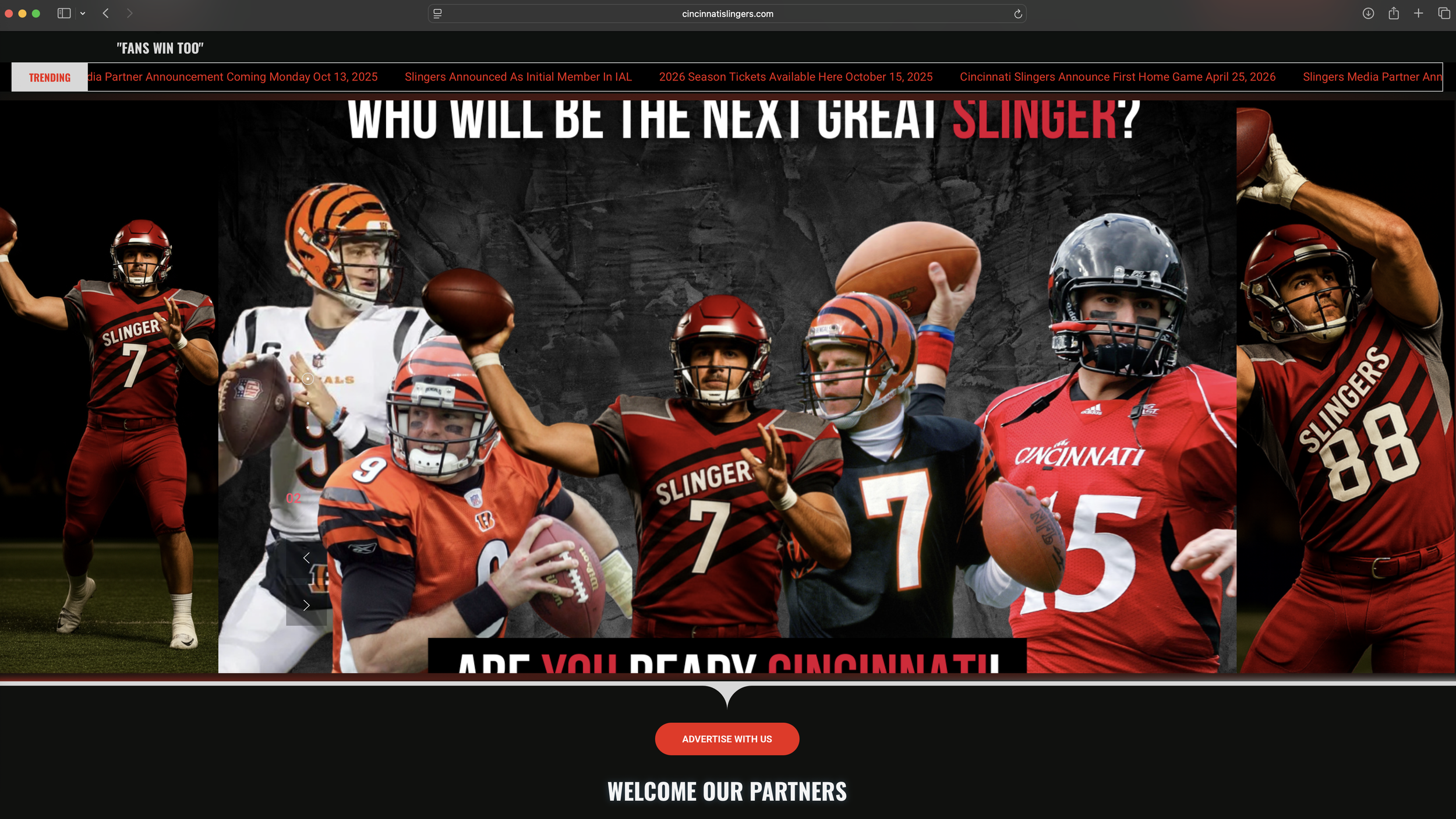
Cincinnatislingers.com as seen on November 17, 2025 at 10:04 p.m.
Throughout the other pages, more AI slop touts not only fun times, but also the notion that “fans win too.” Allegedly season ticket holders of the championship team will “get renewed season tickets” while the winning players take home the “$2 Million Prize.” While these are objectively cool promotions, the sincerity of such statements is undercut by the comically amateurish appearance of everything.
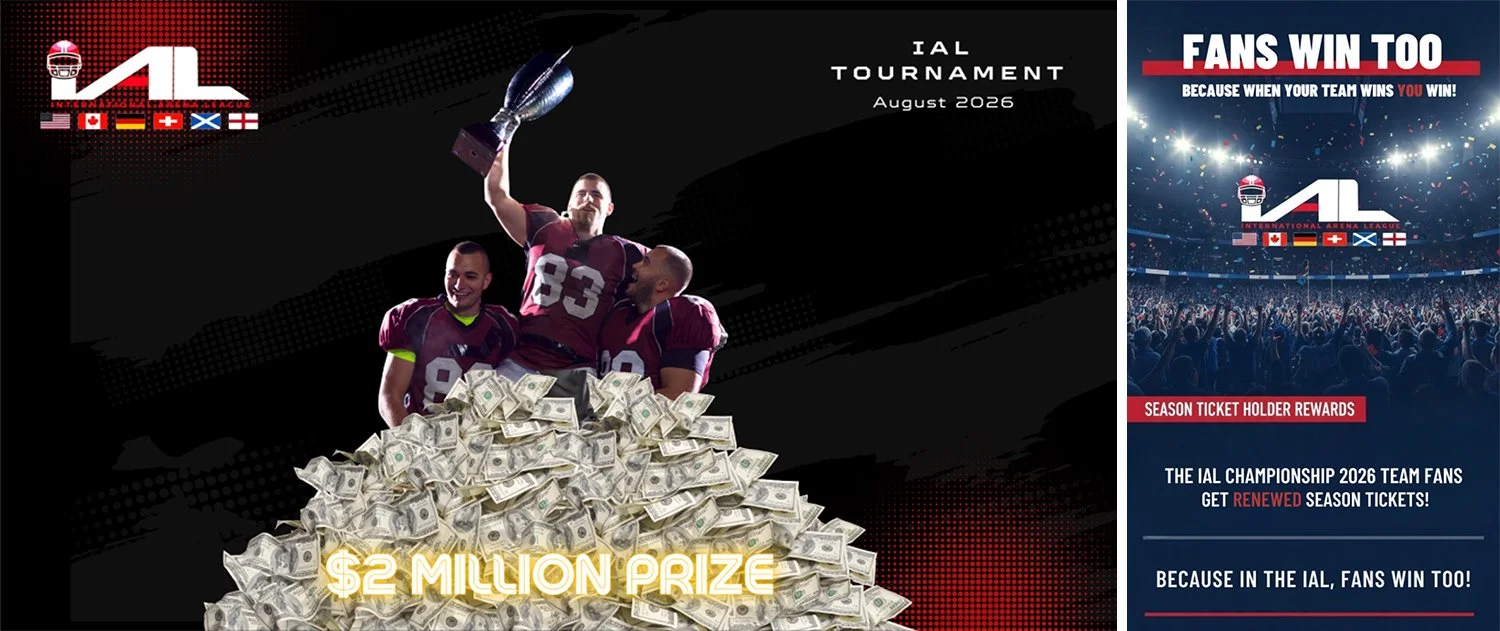
Imagery from IALFootball.com on November 23, 2025 highlighting the “$2 MILLION PRIZE” and “Fans Win Too” promotions.
Still, any upstart league could be forgiven for being cheap (or in this case: incredibly cheap), but with both the Slingers and the IAL—it’s the lack of information that really makes one question how close this effort truly is to reality.
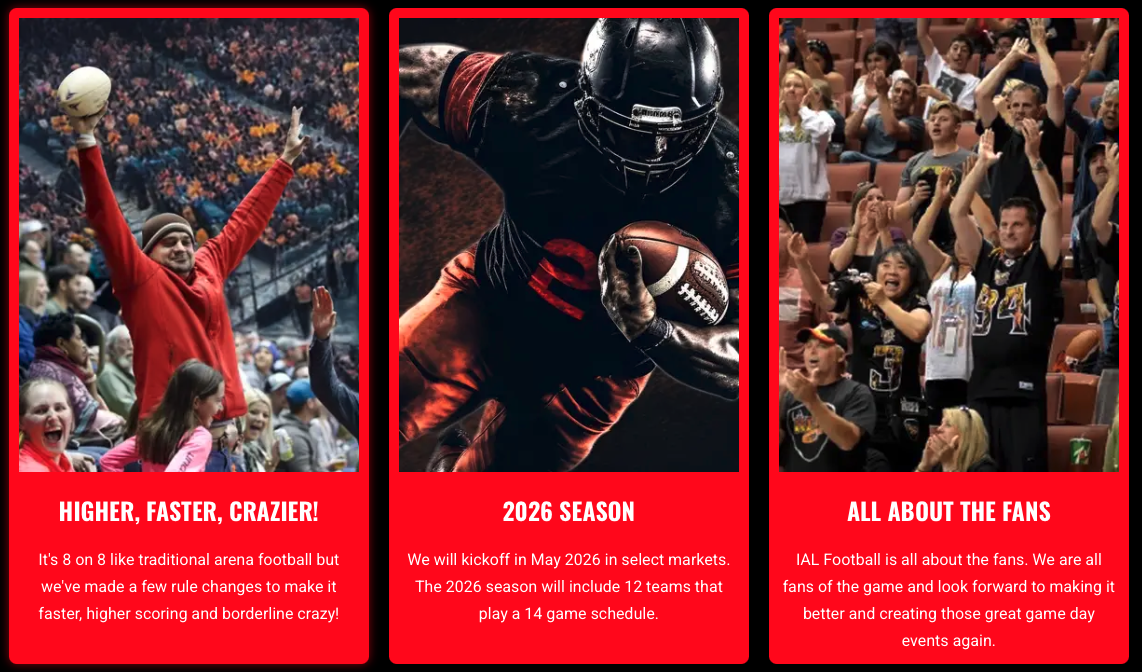
After a while, I started to feel like I was a detective assembling a mystery board—consumed by the case late at night while using twine and push pins to connect the dots. There were just so many inconsistencies between the various websites, low-effort social media posts, “no refund” ticket options, and even a local radio interview that I started to worry that I was becoming Tim Robinson’s character in The Chair Company.

So, I reached out to the team, the league, the venue, and the radio station.
Yet, neither the team, the league, the venue, or the radio station replied to my inquiries within what’s been well over a week now.
The IAL didn’t even have a “contact” or “press” section on their site and I had submit my info through a form that was meant for recruiting players and coaches (I did eventually find a proper form, but it’s not actually linked to the main website and the phone always ends in voicemails).
Though no one had responded, the league was active on social media sharing creative content such as: “Drafted while on the toilet: RB Rebuen Droughns Draft Story” (they meant “Reuben”). They would also occasionally update the “trending headlines” of their various websites. And while those don’t link to anything, they were curious. Particularly this one:
“IAL To Release Team Names And Schedule Tuesday.”
So, on a Monday night, I put off publishing yet again in the hopes that whatever Tuesday they were referring to would be the next day.
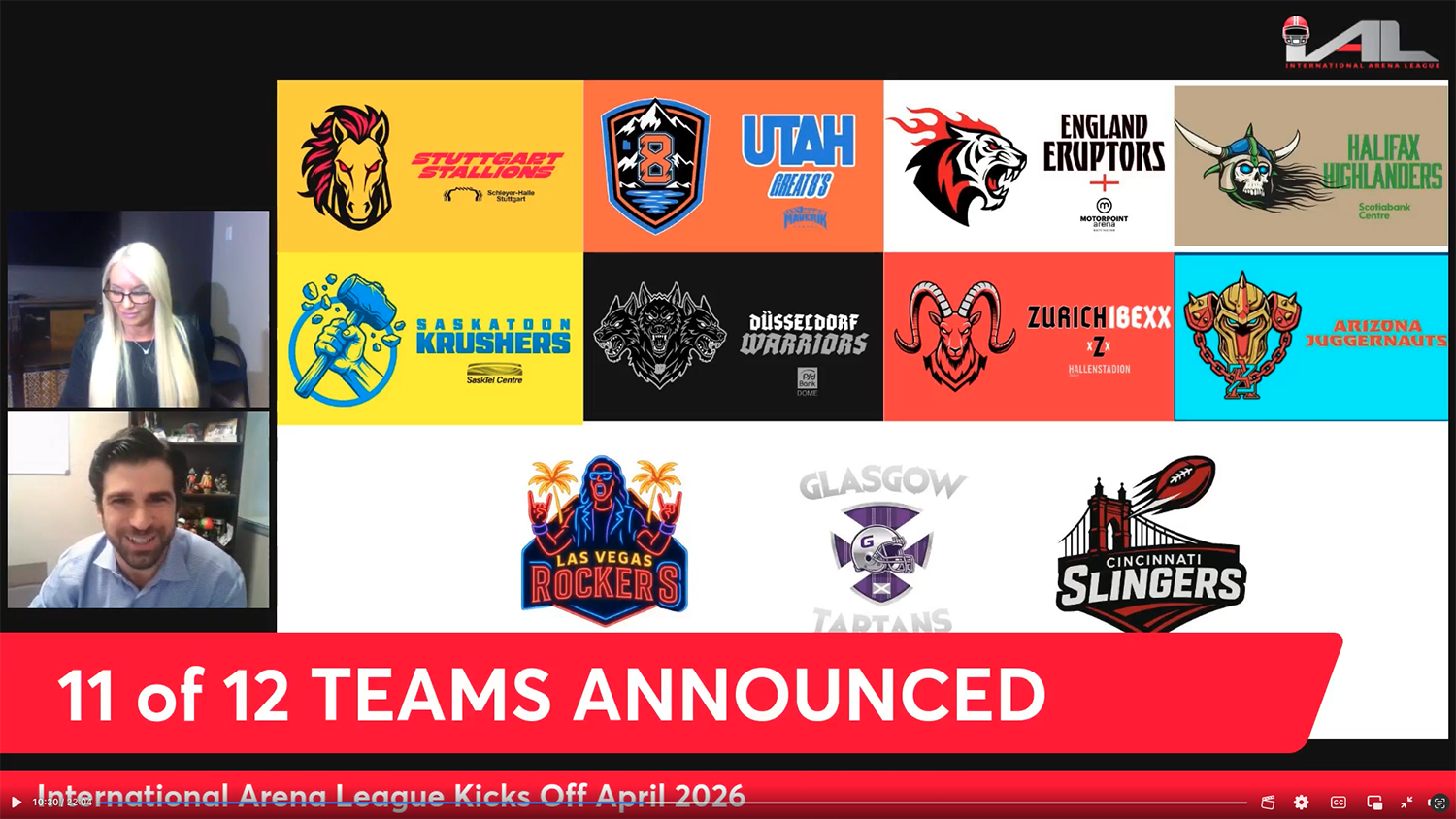
And it was!
Over what was essentially a Zoom call broadcaster over Facebook Live, the International Arena League announced 11 of its 12 teams on November 25, 2055 with the Cincinnati Slingers being among them.
Not sure why Las Vegas got the “Rockers” name over us, but the IAL doesn’t seem too concerned with details.
For its part, Cincinnati’s Heritage Bank Center currently makes no mention of the Slingers on their website, but the arena has at least acknowledged the team once on social media. And in that aforementioned radio interview, “Big Dave” said that the IAL will be the “cream of the crop” when compared to its competition while league COO Tom Mitchell repeatedly mentioned “pyrotechnics” and “tee-shirt-tosses.”
And lest we forget, as the league’s official hype video says: “This is not just another league, it’s…
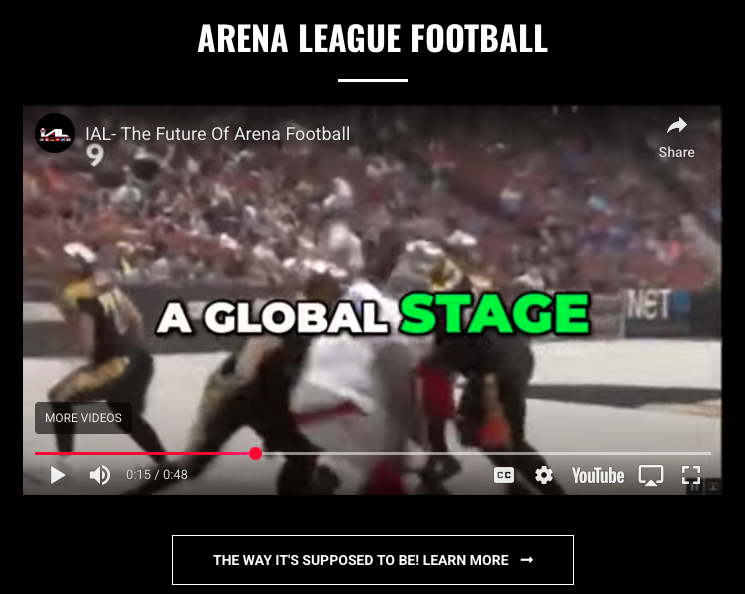
A GLOBAL STAGE.
This video, by the way, is just another user’s video that they’ve “borrowed” and paired with an AI voice.
One of the few non-AI generated images on the Slingers website shows a man among a crowd, presumably celebrating after he’s caught a loose ball at an indoor football game.
“This Could Be You!” the text reads.
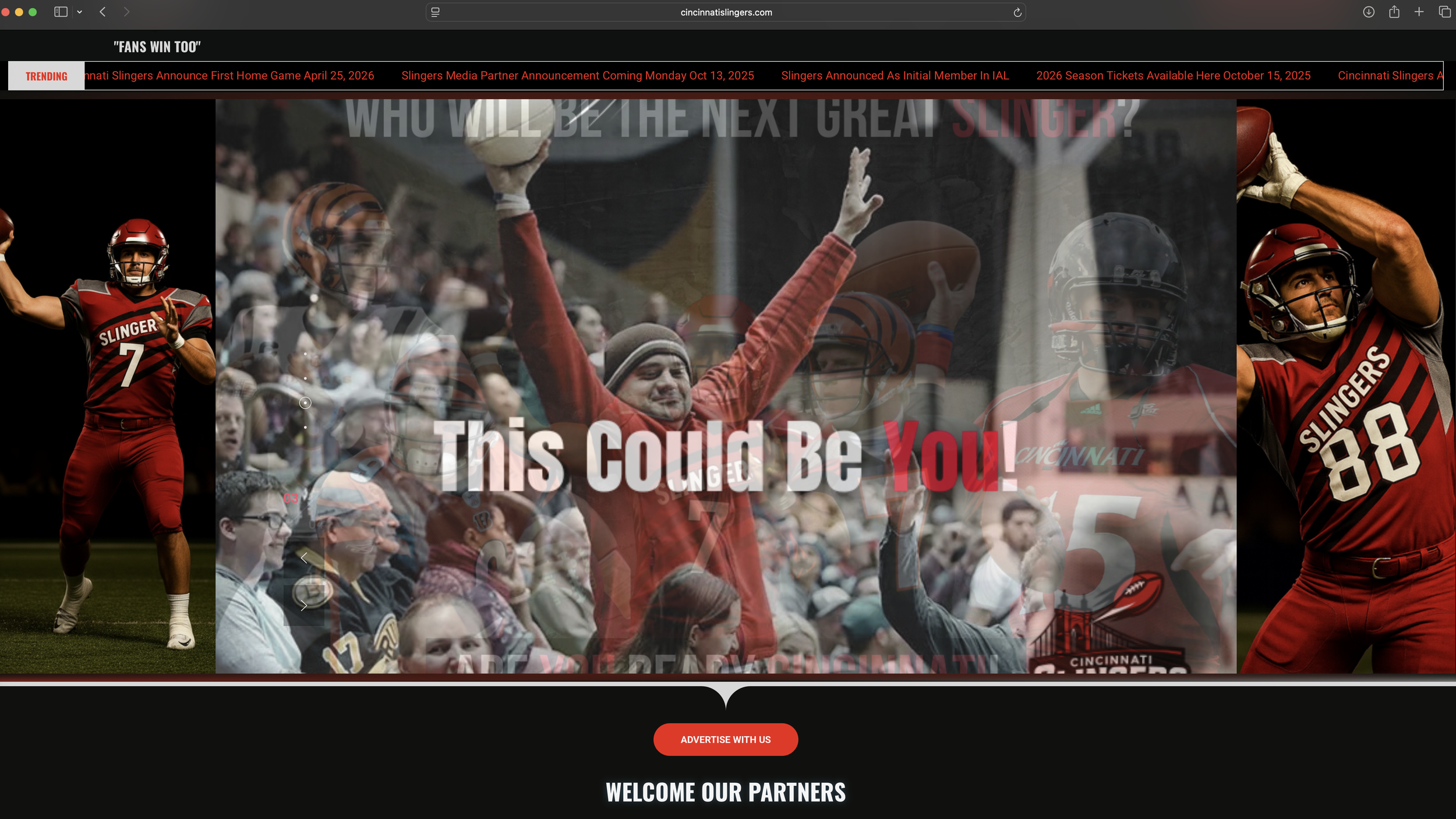
Sure, it could be.
And if these folks manage to launch their global version of this incredibly niche entertainment option that had its best days long ago—I’ll happily cheer it on from the old Beehive with a High Life in hand…
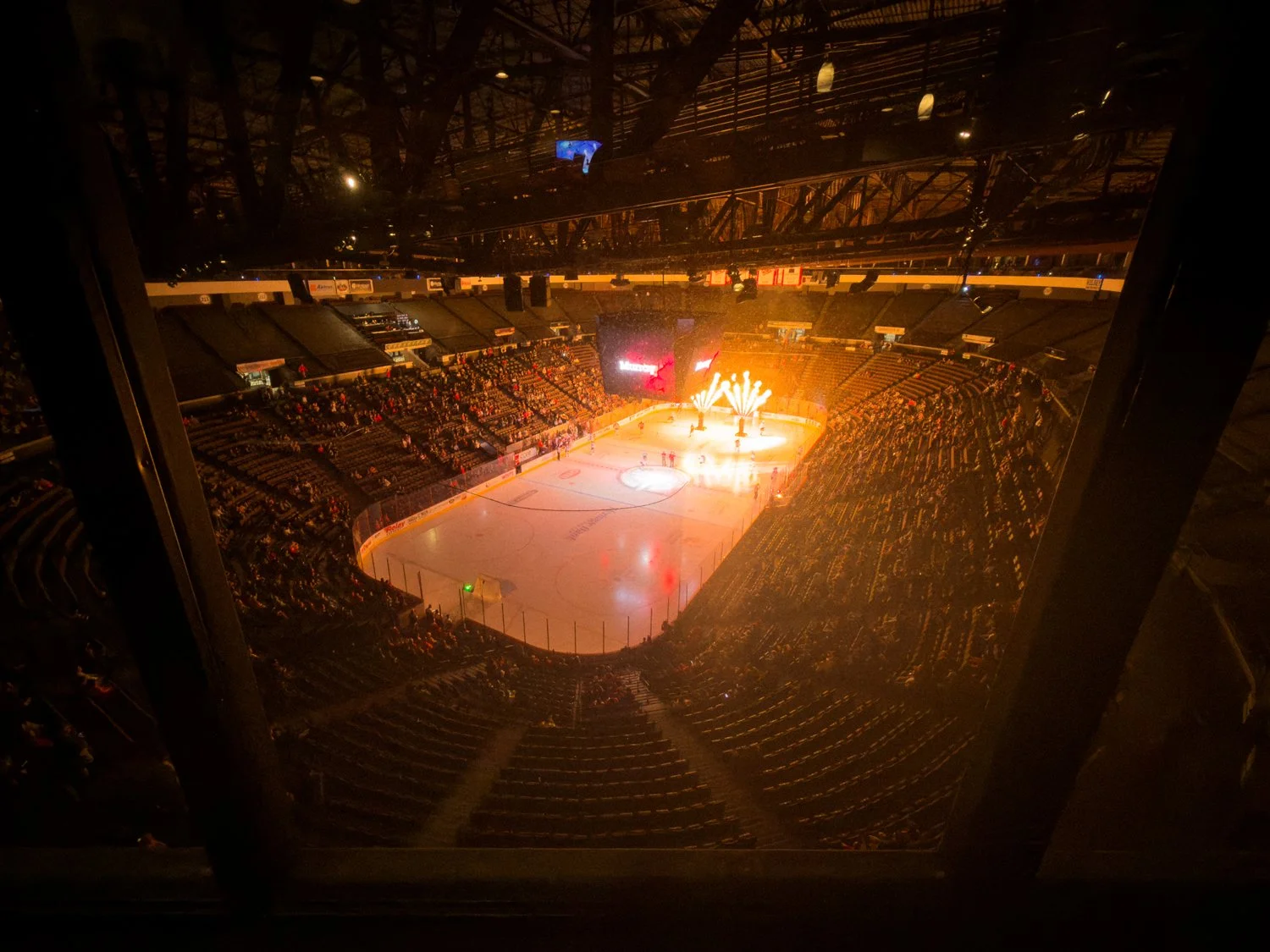
…but, I have a sneaking suspicion that I’ll only have the chance to be a Barrels fan.
Epilogue:
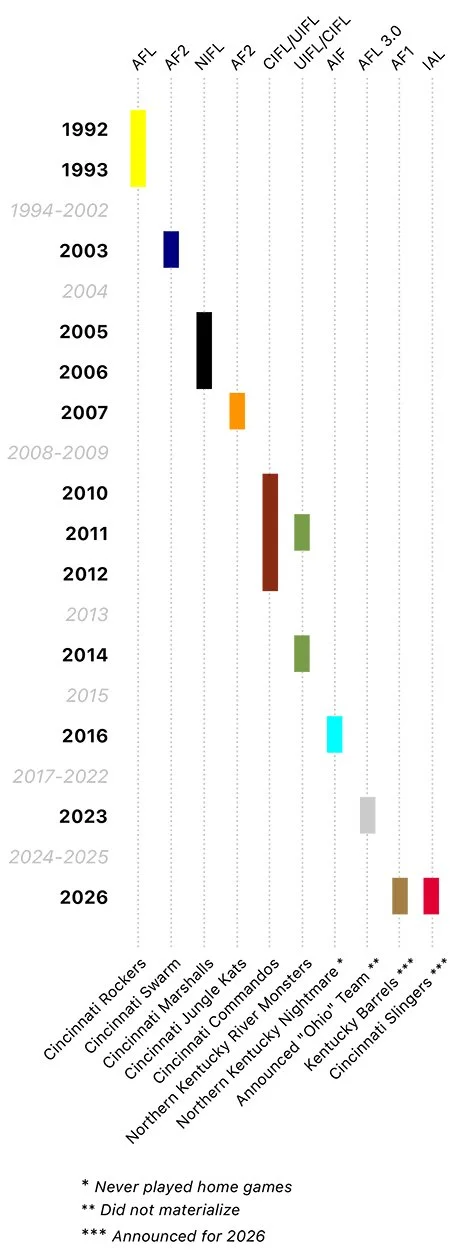
The Timeline
¹ Like an Applebee’s in the sky and I mean that in a good way.
Update | May 1, 2026:
The Cincinnati Slingers actually managed to play a game. Though their league’s legitimacy may still be in doubt, I hope to watch them form the enticing environs of “the Beehive” if they’re still in business two weeks from today and I have no other pressing matters to attend to/don’t completely forget.
Update | May 19, 2026
Somehow, the Slingers slung.
Since 2007, the content of this website (and its former life as Queen City Discovery) has been a huge labor of love.
If you’ve enjoyed stories like The Ghost Ship, abandoned amusement parks, the Cincinnati Subway, Fading Ads, or others over the years—might you consider showing some support for future projects?