Hustler Plaque - Draft Edit - PRIVATE LINK
The title(s) of “Cincinnati’s oldest bar and/or restaurant” is bestowed, seemingly at-will, depending on which piece of local clickbait you come across.
Most would probably argue that Arnold’s has the strongest claim to the subjective throne, but despite being a longstanding, iconic watering hole — the place didn’t have a kitchen until prohibition. Grammer’s donned the crown(s) for a while and so did Mecklenburg Gardens, but they’re both gone (once again (just for now (hopefully))). Scotti’s is still going strong under the same family ownership, but the focus there is certainly on the iconic Italian food rather than drinks. Meanwhile, O’Malley’s in the Alley actively advertises itself as the city’s “second-oldest bar.”
You can scour newspaper archives and read “about us” sections all night long, but the question(s) of “who was first” or “who’s oldest” is (are) almost insurmountably vague. And at the same time, any “answers” you receive will undoubtedly require a number of asterisks.
Do those 13 “dry” years of prohibition count as a “reset?”
What if a place shut down for a bit then got new owners?
How about Covid-19 closures?
All of this depends on who you talk to, which places claim to have been speakeasies, and several other anecdotes of local lore and legend.
For its part, the City of Cincinnati never responded to my inquiries, but the concepts of dining and drinking certainly predate modern record-keeping, permitting, and licensure.
And what is “Cincinnati” anyways?
The civic borders which hold 300,000 or so citizens, or, the entire metro area which encompasses three states and over 2 million individuals? If you cast the net wide enough, you could technically count the Golden Lamb in the northern exurb of Lebanon since it’s been continuously operating since 1803.
Let’s stick with the city center, though, and take all of the “about us” paragraphs at face value: Arnold’s claims 1861 and Scotti’s 1912, while the dearly departed Mecklenburg Gardens and Grammer’s touted 1865 and 1872 respectively. Yet, none of these cite “1864,” which is what a random plaque on Elm Street vaguely declares:
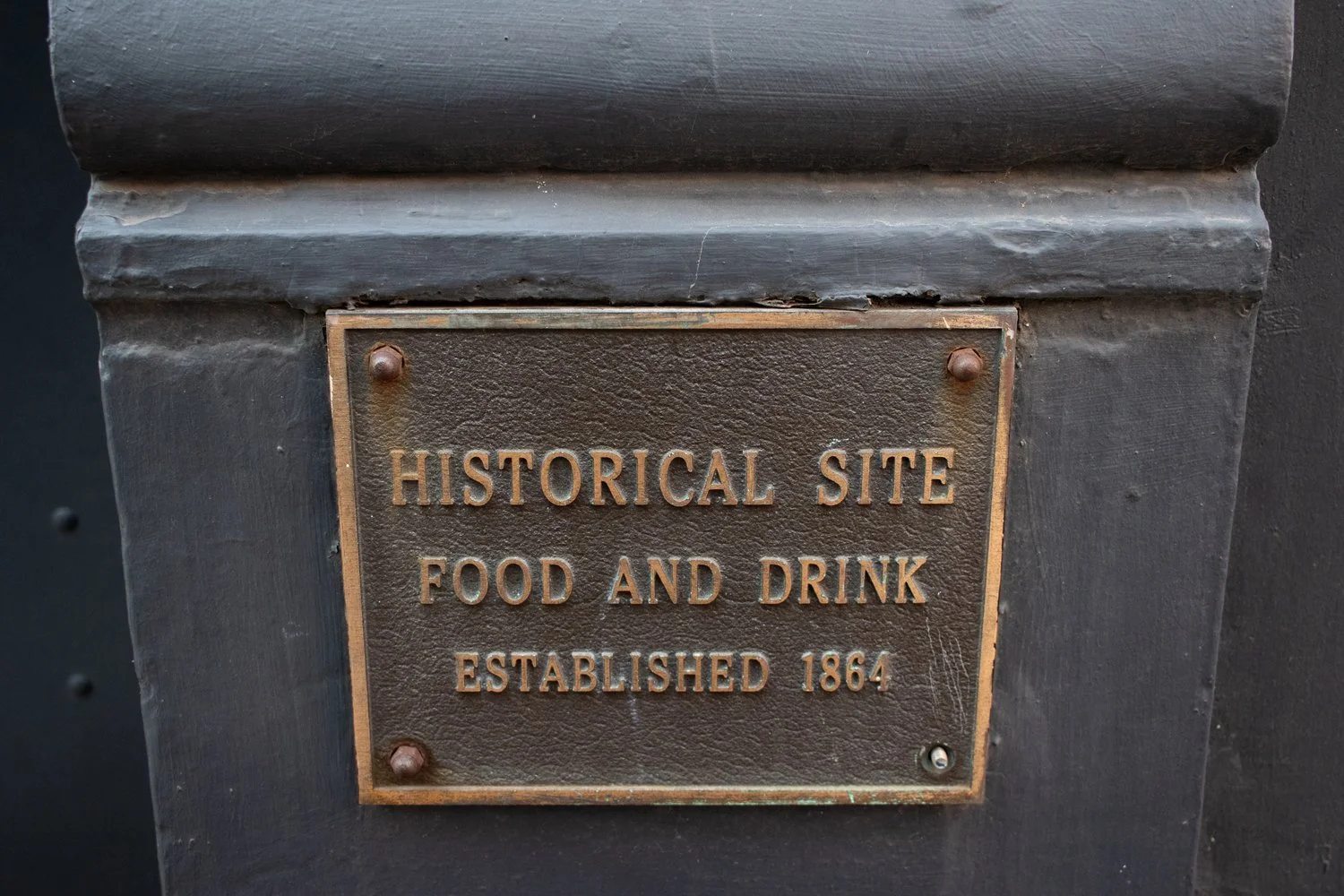
The plaque at 411 Elm St.
The woman’s head was flung backwards and upside down, hair falling and flailing as she gripped the trapeze above. Surrounding these boxes of WhipSmart™ Pleasure Swings were shelves of lingerie, adult novelties, and surprisingly: DVDs. Granted, physical media is making a comeback and this was a store catering to physical pleasure, but that didn’t explain the historical marker out front. And even if Larry Flnyt’s Hustler Express was offering an assortment of edible massage oils, body paint, pasties, panties, and cock rings — I was beginning to suspect that the bronze proclamation of “FOOD AND DRINK ESTABLISHED 1864” wasn’t in reference to this specific business. A kind employee confirmed this as we spoke at the register above a glass counter containing the high-end, rear-end products.
“I think it was a soda fountain,” they said.
As good a guess as any considering this address wasn’t listed on the National Register of Historic Places or among the city’s designated “Local Historic Landmarks.”
Greg had a few good leads, though.
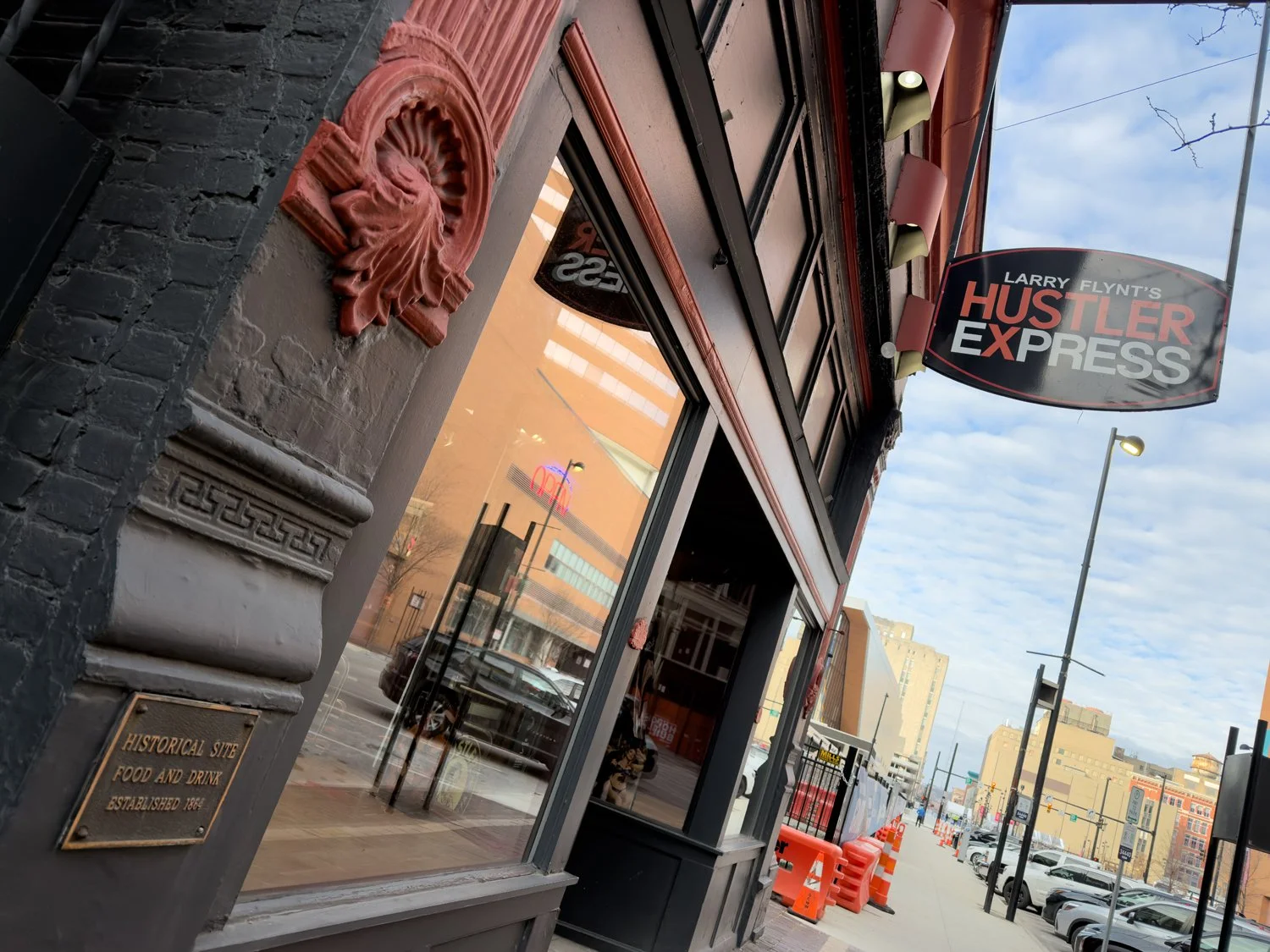
The plaque seen mounted on the outside of Larry Flynt’s Hustler Express in 2026.
If you’re not familiar with the work of Greg Hand, he’s the talented individual behind Cincinnati Curiosities. Someone who’s “working overtime to keep alive the weird soul of the Queen City.” A good chunk of the following information came from him:
The 1887 Sanborn Fire Insurance Map lists the address as hosting doctors’ offices and a drug store
Other historical references mention a typewriter repair shop, printing operation, and even advertise the building as having “Factory Space For Rent”
Joseph Wahle, “president of the Saloon-keepers’ association” in 1889, had an establishment at this address
Otto Kelm operated the Merchants Cafe there in the first part of the 20th century
Saul “S.J.” Younger eventually opened a restaurant at the location that was reported to have been called “The Elms” or “Elms Cafe” as early as 1938
S.J.’s son, Mike, then opened his own dining venture on the spot in 1975
It’s the efforts of Mike Younger that may provide a few clues about the plaque. Featured in the Cincinnati Post on October 24, 1975 — just one day after a grand opening — the newspaper profiled “S.J.’s Red Garter Saloon.” Not just “Cincinnati’s newest restaurant,” but also “the only place in town with a salad bar in an antique bathtub.”
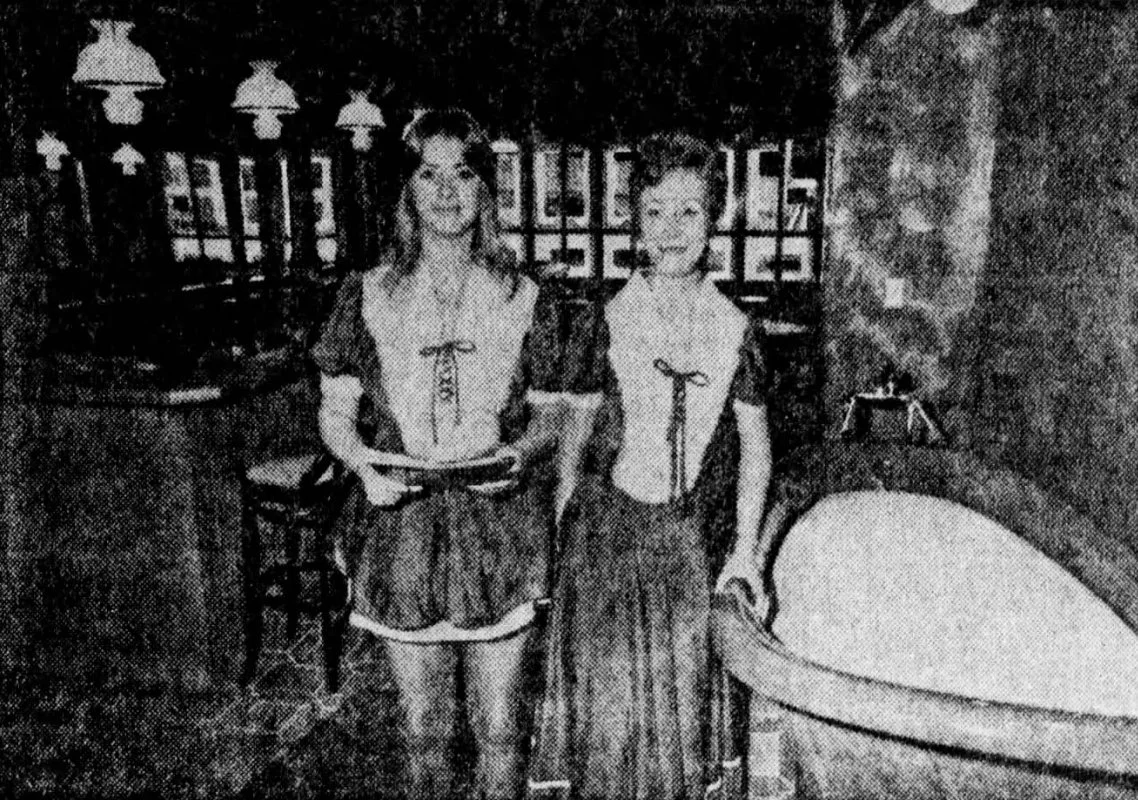
Waitresses Peggy Martin (left) and Barbara Brinkman (right) standing by the antique bathtub of S.J.’s Red Garter Saloon as seen in the Cincinnati Post on October 24, 1975.
That bathtub was just one of many unique decorations heralded by the paper alongside “an enormous Moose head, old-fashioned design bentwood chairs, antique knick-knacks” and two elements original to the building: a “tin ceiling and huge mirrored bar stripped down to its’ original beauty.” The place prided itself on serving “over-stuffed sandwiches” and “charcoal broiled dinner fare” such as steak, ribs, and seafood.
The theme was meant to evoke a “rollicking late 19th century atmosphere,” but when it comes to actual history — the paper only casually mentions that the “brand-new restaurant-saloon” is “over 125 years old.” A date which, at minimum, implies 1850 — fourteen years before the 1864 date found on the plaque.
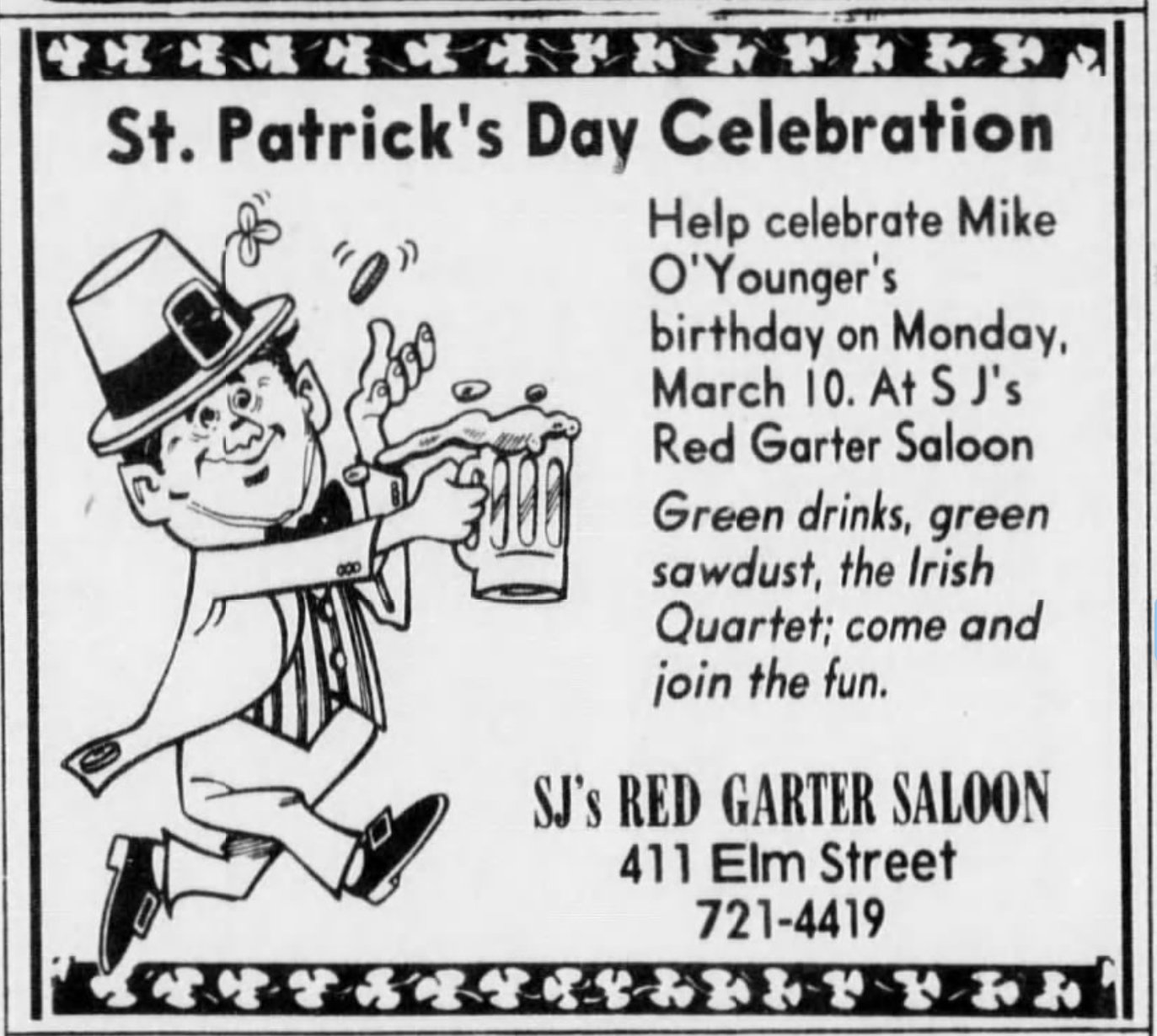
Advertisement for a St. Patrick’s Day party at S.J.’s Red Garter Saloon as seen in the March 15, 1980 edition of the Cincinnati Enquirer.
S.J.’s Red Garter Saloon seemed to have a good run, regularly advertising its specials and events over the next decade before undergoing a series of rebrands. At one point it became the “SJ Steak N’ Rib House” and then eventually reverted back to both “The Elms” and “Elm Cafe” monikers.
Though Mike owned the restaurant, he was leasing the space from the City of Cincinnati who, in 1992, would increase his rent. In the Cincinnati Post’s coverage of the situation, they would state that “Elm Cafe is in a brick building that began as a club for riverboat captains in 1864” while also mentioning that the restaurant features “skillfully crafted oak that has served as the building’s bar since the Civil War.”
A Cincinnati Enquirer article from May of 1994 would later recall “a long legal battle over the lease of the building” which resulted in Younger being evicted. This piece also stated that “the building that housed the Elm Cafe has been an eating and drinking establishment since 1864.”
Finally, in 1996, another Enquirer article would make mention of “1864” while lamenting how the space had been empty since Younger was forced out:
“People still walk by the Elm Cafe, 411 Elm St., and press their faces against the window to see inside. They see emptiness and dust, but nothing to remind them of a once-proud Cincinnati tradition where a restaurant with an early American decor had served fine food since 1864.”
While these examples would seem to give some context to the plaque — or even hint at an answer — there’s one piece of potentially conflicting information: per County property records, the one-story building at 411 Elm St. was constructed in 1885.
Granted, other buildings had likely been at that address or perhaps had been incorporated into the structure that’s still there today, but following this particular subject even further down the historic rabbit hole gets both increasingly challenging and murky.
What is clear is that Mike Younger and his family had longstanding roots at the address and were passionate about the building’s history.
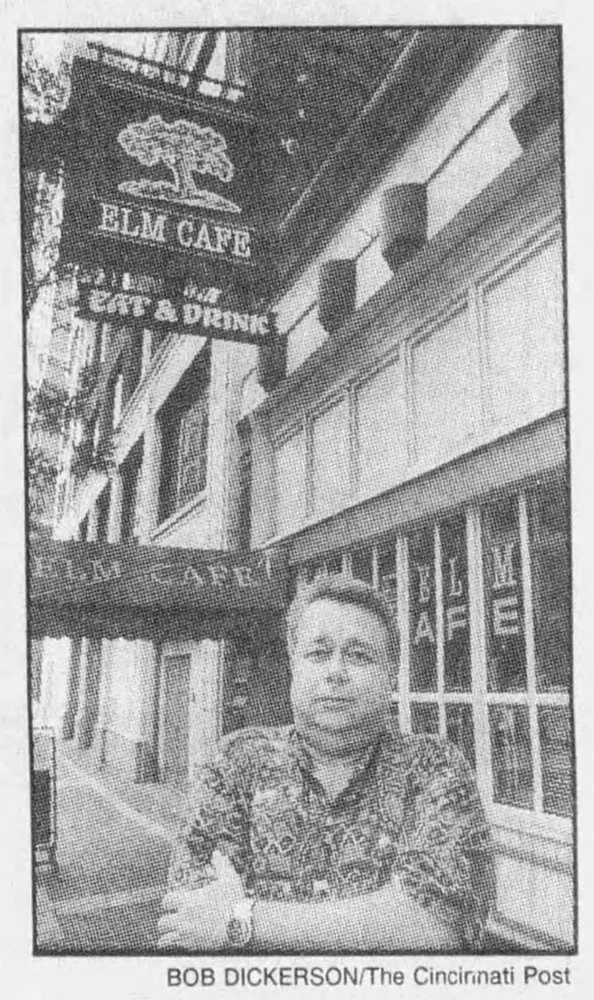
Mike Younger as seen in the Cincinnati Post on July 29, 1992.
Did they place the plaque, though?
Is there something “official” out there which confirms whatever it is that it’s referencing?
Or is it all just a bunch apocryphal hearsay lost to time?
For me, at least, this is where the trail went cold, but not exactly where this particular story ended.
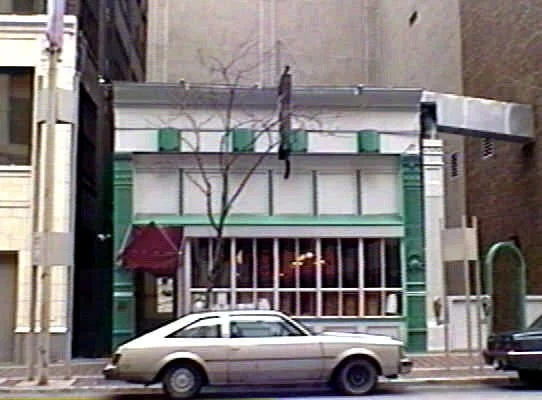
A June 25, 1993 photograph of 411 Elm St. from the Hamilton County Auditor.
The City would eventually sell the property to a developer who’d bring in a Hustler store, though not one to be confused with the other Hustler store that just a few blocks away…
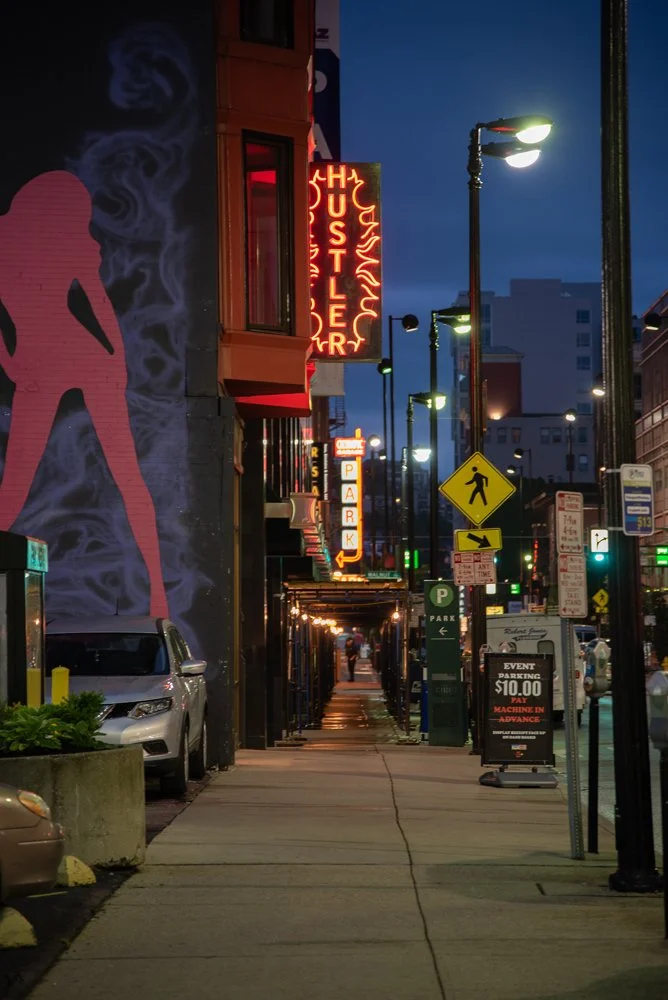
The 7th St. Hustler store seen in 2016. Photograph by Phil Armstrong.
…or the now gone Hustler club (and its store) which had sparked a lot of local, Larry Flynt-related controversy.
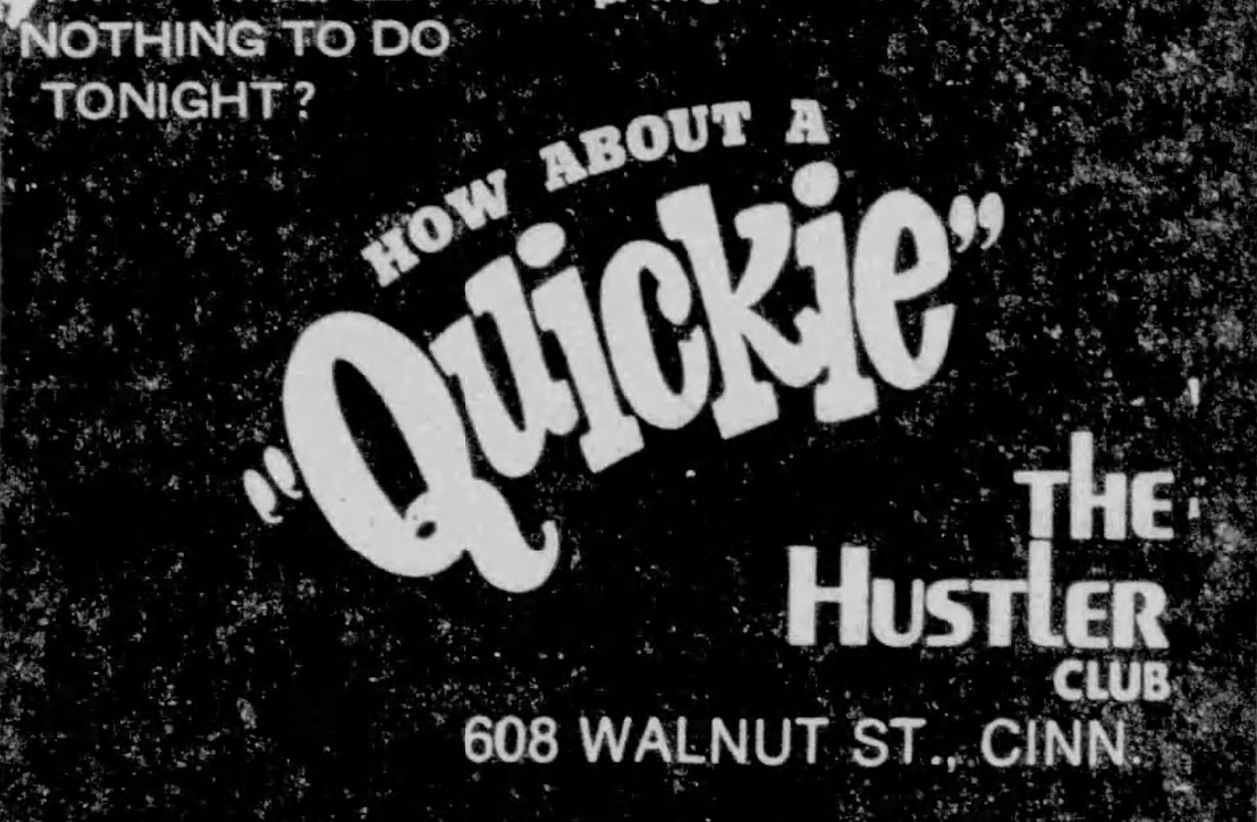
Advertisement for The Hustler Club in the March 22, 1974 edition of the Cincinnati Post.
All of which — though definitely unrelated to the random plaque — are still interconnected, interesting pieces of history in their own right.
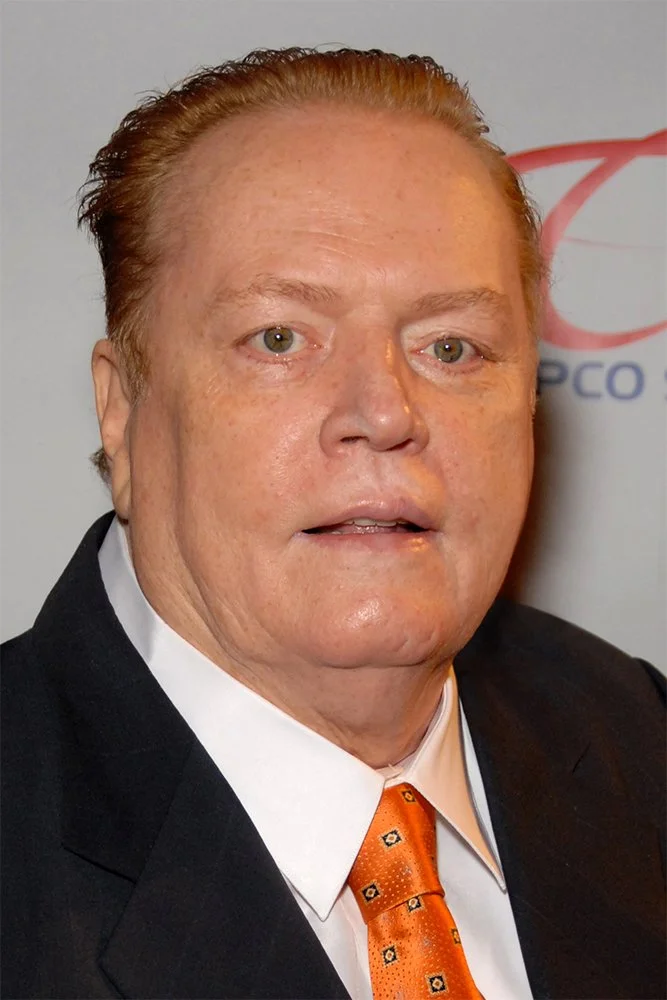
Hustler founder Larry Flynt in November 2009 as photographed by Glenn Francis/Pacific Pro Digital.
Larry Claxton Flynt Jr. hailed from Eastern Kentucky, growing up poor in the wake of World War Two before moving across the Midwest in search of employment. He had stints in both the Army and Navy, once claiming to have been the radar operator on duty when the USS Enterprise recovered John Glenn’s space capsule (coincidentally, Flynt and Glenn would both unsuccessfully vie for the Democratic nomination in the 1984 United States presidential election).
It was after this military service that Flynt would become a bar owner in Dayton, Ohio. Upon finding success, he sought to expand into the world of higher-end, nude cocktail bars or “go-go” clubs. He chose the name “Hustler” and, along with his brother Jimmy, opened his first location within the Gem City before expanding throughout other Ohio cities, including Cincinnati.
Flynt had the idea to turn his club’s newsletter into a widely available magazine and Hustler would hit shelves in 1974, immediately gaining a reputation for containing content that was often more graphic and lewd than what could be found within the pages of competitors like Playboy. In particular, Flynt and his new publication would garner infamy in 1975 for publishing nude photographs of former-First Lady Jacqueline Kennedy Onassis that’d been taken without her consent by a voyeuristic paparazzo while she was sunbathing.
As Hustler’s circulation grew and Flynt’s various enterprises expanded, he often caught the ire of his fellow citizens. Though a self-described champion of free speech, the bombastic businessman would regularly become embroiled in legal battles, some of the most notable occurring within Cincinnati.
In 1976, then-Hamilton County Prosecutor Simon Leis charged Flynt with obscenity due to the distribution of his magazine. Though the well-known conservative politician would get a conviction, Flynt’s sentence would eventually be overturned on appeal. This incident, as well as several other court cases, would serve as the inspiration for the 1996 film The People vs. Larry Flynt starring Woody Harrelson, Edward Norton, Courtney Love, James Carville, and even Flynt himself in a cameo role.
By that point, however, the Cincinnati Hustler club was long closed and Flynt’s magazine had become his primary business as Hamilton County moved on to other legal battles over censorship and obscenity such as the 1990 Robert Mapplethorpe situation.
Though Flynt had become wheelchair-bound in 1978 due to a failed assassination attempt, the man had remained both outspoken and driven — eventually expanding Larry Flynt Enterprises into both pornography distribution and retail.
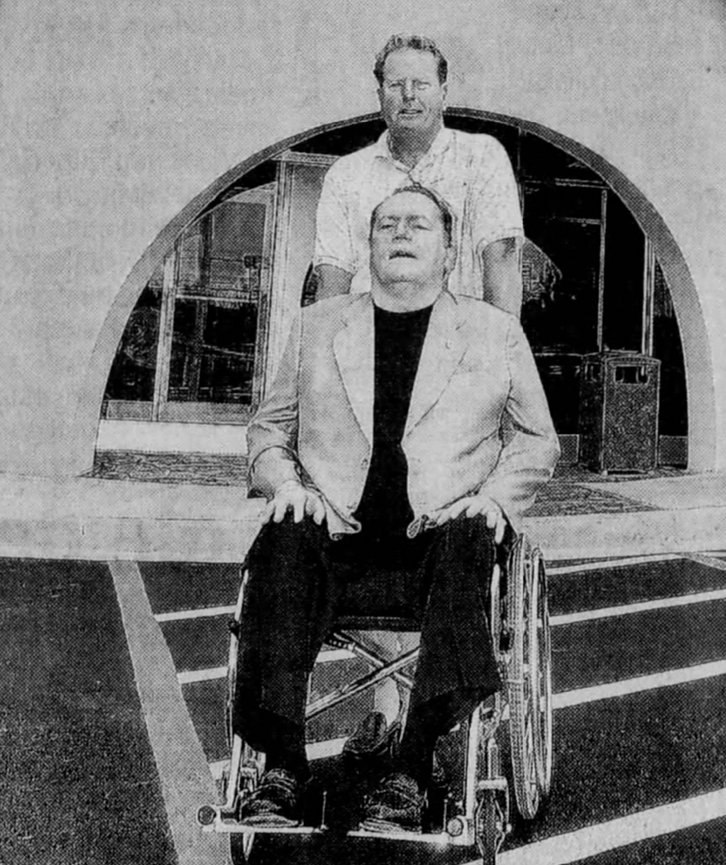
Larry Flynt (seated) and his brother Jimmy Flynt (standing) outside of the Lexington, KY Hustler retail store in 2004. File photo used in the May 23, 2009 edition of the Cincinnati Enquirer.
Flynt’s original downtown Cincinnati club and store were both closed to make way for new development in the late 1990s. Though he generated controversy and still challenged local obscenity laws while searching for a new retail location, Hustler would eventually land on the former restaurant space at 411 Elm St. where a vague plaque stood out front. This Hustler store would be operated by Larry’s brother, Jimmy, but years later — a family feud would lead to the opening of a rival, competing store (known as “Hustler Hollywood”) controlled by Larry’s company.
Thus, despite the efforts of local politicians and conservative citizen groups to keep the Flynts out of Cincinnati — the city center wound up with two stores, as well as, several other locations throughout the region.
[Shot - 7th Street Store in 2026]
At some point, though, the feud seemed to have been resolved. Larry would pass away in 2021 and both stores are now listed as locations on HustlerHollywood.com. The 7th St. location still stands as “Hustler Hollywood” while “Larry Flynt’s Hustler Express” remains at 411 Elm St — the same spot where a mysterious plaque hints at some obscure “food and drink” history that I still can’t figure out.
Since 2007, the content of this website (and its former life as Queen City Discovery) has been a huge labor of love.
If you’ve enjoyed stories like The Ghost Ship, abandoned amusement parks, the Cincinnati Subway, Fading Ads, or others over the years—might you consider showing some support for future projects?